Raise the Hammer

The lowly bicycle could be a key to our long-term survival.
By Ryan McGreal
Published September 20, 2006
Thanks to the triumph of motorized vehicles over the past century, North Americans, who constitute some five percent of the world's population, consume fully a quarter of the world's energy.
The sprawl built environment that grew out of car use is the most wasteful arrangement in history, swallowing energy, materials, and farmland at a breathtaking rate.
Runaway sprawl, combined with the rise in biofuels production to power more vehicles, has driven the world's grain production into sharp decline, even as the number of people who need to eat continues to grow.
The car's insatiable greed for space has destroyed existing neighbourhoods and deformed new developments. Cars demand wide roads, deep driveways, two- and three-car garages, and vast expanses of surface parking, which pushes destinations so far apart and so compromises pedestrian infrastructure that it becomes difficult to walk or cycle anywhere.
At the same time, the displacement of space and proliferation of highways means commuting distances keep increasing, resulting in more time spent behind the windshield. Weary commuters, in turn, are more likely to eat unhealthy prepared meals and less likely to exercise.
This confluence of factors has stalled the rise in average life expectancies and caused a dangerous spike in obesity, heart disease, type 2 diabetes, and other so-called lifestyle diseases.
The colossal North American consumption of transportation energy, and the efforts of other economies to catch up, threaten to outstrip the oil industry's capacity to extract and refine petroleum fuels. With so much of our built environment already dependent on cheap, abundant fuel, a global peak in oil production could be devastating once production goes into decline.
Finally, the combustion of all that fuel is releasing carbon into the atmosphere at such levels that the planet's ability to regulate temperatures and water cycles is now compromised. This is already having myriad effects across the planet, and we can only expect this to continue as climate change alters our very seasons.
That climate change is taking place and influenced by human activity is no longer in dispute. In fact, thanks to some unexpected positive feedback loops, the change is accelerating faster than even pessimistic scientists had predicted.
What if someone invented a vehicle that had a long range and an average speed that matched cars in today's city streets, took up very little space for use and storage, operated in a variety of conditions both on-road and off, and provided phenomenal fuel efficiency?
What if that vehicle already exists? I'm talking about the humble bicycle, long considered a child's plaything in North America, but a possible key to our long-term survival.
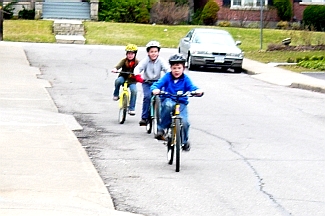
Bicycles are not just children's toys (RTH file photo)
As Ted Mitchell recently demonstrated, "The bicycle is the most efficient form of personal transportation ever invented." He explains:
People of average fitness can achieve 20 km/h with an average power input of about 1/10 hp, or 75 watts. This level of exertion is minimal and can be kept up for hours.
Leg muscles are about 20 percent efficient, so a five kilometre ride consumes 80 kilocalories, or about one small apple. If you are wondering, this translates into a fuel efficiency of 595 km/l (1,400 mpg) of gasoline. Apples are renewable and clean; gasoline is neither.
Now there's a biofuel I can get behind.
Mitchell points out that in city driving, bicycles average close to the same speed as cars, since they have more available routes and avoid delays to find parking. Further, cars waste a lot of time racing from light to light. Bicycles often end up arriving at intersections behind cars, just as the light is turning green.
Unlike cars, which are major contributors to the rise in chronic disease, bicycles also provide a net improvement to health. Again, as Mitchell argues, "Cycling to work is all the exercise you will ever need. The risk reduction for heart disease and diabetes alone is worth billions of dollars, not to mention the myriad other benefits for which car slaves are experts in denial."
Bicycles are cheap to manufacture and cheap to maintain, and the savings can go toward offseting the inevitable rise in energy costs for home heating and cooling that will come with peak oil.
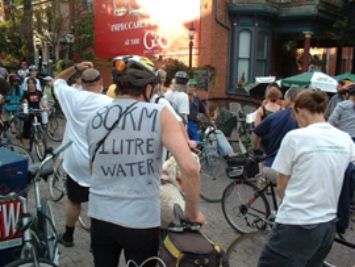
Cyclists at a Critical Mass bike rally. Hamilton has CM rides on the last Friday of every month, starting at Hess Village
Bicycles would improve the safety and comfort of neighbourhoods. Less massive, quieter, and slower moving than cars, bicycles are much safer for pedestrians than cars - especially when they ride on the road instead of the sidealk - and much less disturbing to passersby and neighbours.
With the aid of bicycles, it may be possible to continue living in suburbs that currently cater to cars. In fact, all that space would suddenly be an asset. Gaps between houses can become paths to connect those winding lanes, bringing destinations closer together and increasing the choice of routes.
Because bicycles use so much less space than cars, garages can turn into apartments or stores, and parking lots can become sites for new multi-use buildings. Those suburbs deemed most likely to survive could gradually intensify into all that space currently set aside for cars.
Also, because bicycles dramatically extend the range that humans can travel, they can help to bridge the gap between today's car-dependent separation of uses and tomorrow's mixed adaptive reuse.
Conventional planning wisdom holds that the average person in a car-dependent development will only walk about half a kilometre, or the distance that an average walker can cover in five minutes. Where cars and "free" parking are ubiquitous, that is probably true. However, personal experience suggests that the average person's walkability index can shift as incentives and disincentives change.
For example, my wife and I went car-free for about six months a few years ago (we're "car-lite" today), and discovered that our sense of what constituted a walkable distance changed dramatically when we no longer had the luxury of jumping in the car and driving around the corner.
Today, I use a bicycle as my main mode of transportation, and when people ask why, I can honestly answer that I ride a bike because I'm lazy and pampered. No, seriously. It takes me about as long to ride to most destinations in the lower city as it would take to drive, and pedaling a bicycle is easy once you're in even moderately good shape. (Note: I am not in particularly good shape.)
It costs nothing in fuel or parking to ride a bike, I can always find a parking spot right next to my destination, and I almost always arrive in a better mood than when I left, since moderate exercise and fresh air are invigorating.
As an added advantage, bicycles grant mobility and convenience to older children and teenagers, who often depend on their parents to chauffer them everywhere or must rely on sporadic, inconvenient transit.
Bikes are not as practical for longer distance trips (although the definition of "long distance" changes once you switch from driving to cycling as your main transportation mode). In these cases, it makes sense to have a good public transit system.
The good news is that with all the available room left by today's car infrastructure, we would have plenty of space to create dedicated transit lines through the city so that bicycles and buses or trolley cars can coexist safely and peacefully. Since their range and uses are distinct, transit and bikes complement each other whereas transit and cars currently compete for space and for users.
The integration of bicycles and long-distance transit are even more compelling. Today, many commuters complain that train service is expensive and infrequent, but trains could partner with bicycles to their mutual benefit.
The catchment area for a bicycle-oriented train station would increase dramatically over mere pedestrian access. The station would no longer require a huge parking lot to accommodate commuters arriving by car, since bicycles take up so much less room. Each station could run very productively and conveniently, with trains at frequent intervals.
Through a combination of cargo trailers and child seats, trail-a-bike trailers or tandem bars, and various types of cargo storage, it is possible for a family to travel together by bicycle. However, it's not easy, and generally consists of cobbled-together, catch-as-catch-can arrangements.
With a little imagination, the basic design behind bicycles could move whole families around in a single, convenient vehicle that incorporates the advantages of cars without all the nasty side-effects. Imagine three- or four-wheeled family cycles with on-board seating for young children and even storage "trunks".
Bicycles can be modified for goods transport and delivery. Many businesses, especially outside North America, already employ bicycle couriers for correspondence, shipment, and food delivery. I've even seen a bicycle pulling a canoe on a trailer.
Just for a moment, set aside all the pragmatic "Yes, but" arguments and just imagine what it would be like to live in a bicycle city. People would have plenty to grouse about, of course, especially in winter, but it's not like the omnipresence of cars has made us happy. Far from it, as the evidence of road rage, stress, and chronic ill-health demonstrate so amply.
Compared to the noisome, dangerous, dirty, alienating car cities we have today, a bicycle city would literally be a whole lungfull of fresh air.
By adrian (registered) | Posted September 20, 2006 at 09:07:43
Climate change will have one beneficial side effect: warmer, shorter winters remove or mitigate one of the main reasons people think bicycle transportation in Hamilton is unfeasible.
There's no doubt a bicycle-oriented transportation system can work. Travel to the Netherlands and you'll see it working, and winters get pretty chilly up there in Northern Europe as well. There is one main difference, however: the Netherlands is very flat.
Anyone whose travels regularly take them up and down the escarpment are going to tell you that bicycle transportation is unfeasible for them (I used to work on the mountain and I did bike some days, but man that stairway climb was gruelling, with my bike over my shoulder).
That's why we badly need city investment in making this form of transportation more viable. First, we need public transportation to embrace bicycles, by creating convenient places to stash them on buses (and on trams, if we ever get those back). And creating some bicycle 'elevators' that run up and down the escarpment would go a long way to helping out mountain residents who work downtown and vice versa.
Secondly, we badly need proper bike paths in this city. Any city I've been to where bicycle transportation is common has them, from Amsterdam to Montreal. Riding on the street is all well and good for the road warrior types - or just those who are young and fit and by themselves - but for bicycle transportation to really be workable in Hamilton, it has to work for everyone. That includes children on their own, parents with children in tow, and the elderly.
Believe it or not, the elderly in some countries really do zip around on the bike paths. But after surviving for decades, not many elderly are going to take their lives in their hands by battling traffic on King Street.
Please, Hamilton, make this city bicycle-friendly!
By jason (registered) | Posted September 20, 2006 at 11:10:40
I agree Adrian Especially in regards to bike lanes and moving up/down the escarpment. Some cyclists say we don't need bike lanes, but imagine if we decided that we didn't need sidewalks - pedestrians and cars all have to share the road way. in North America, we need bike lanes...on every street. incline railways, bike friendly stairs, bike lanes on the mountain accesses and bike racks on every HSR bus would make cycling a better option for cross-commuting the escarpment. The folks in International Village who developed the master plan for Ferguson Avenue also dreamt of bringing back an incline railway someday from Sam Lawrence park to the downtown area. That would be perfect for cyclists and pedestrians.
By David Christiansen (anonymous) | Posted September 21, 2006 at 09:39:40
In Denmark, another bike-heavy place, there are bikes known as "christiania bikes" that have two front wheels with a big box between them. Many of these bikes use the front box for cargo, as originally intended (Christiania is an area of Copenhagen where personal cars are prohibited), but many people can be seen with a bench with seatbelts added, carrying up to three children with one parent pedaling. These bikes are quite cool!
By Jonah (anonymous) | Posted September 21, 2006 at 12:58:28
You can live in very bicycle-friendly cities if you move to Japan/SE Asia. The dearth of auto traffic on Japanese surface streets as compared to any comparable US city is a joy to behold, and the urban footprints of train stations with bicycle parking is significantly reduced. Imo the rain/snow issue is a bit less trivial than you infer. Japan made the deliberate choice at the top to build out rail infrastructure and so urban neighborhoods radiate out from the stations, it will take crisis conditions before bicycles become top choice if you are living an onerous distance from rail in a snowy climate.
By Ramond (anonymous) | Posted September 21, 2006 at 14:33:28
I completely agree and really wish we had a more bicycle-friendly environment.
I think there are many others who would agree.
Can you make any suggestions as to whom we should contact and make our feelings known to?
All these great ideas but
we would also like to know
how to go about build upon it.
Thanks,
Ray
By leTwist (anonymous) | Posted September 21, 2006 at 14:48:49
i fully agree. great articel!
By Hans (anonymous) | Posted September 21, 2006 at 15:34:30
Thank you, great article! In my oppion every day I see more bicyles around me.. :)
Best Regards from Germany
Hans
By gcruik (anonymous) | Posted September 21, 2006 at 18:10:39
One way for this to happen:
Increase the price of gasoline/diesel for autos to about $8.00 to $10.00. Taxes could do it.
That is probably the actual cost of gasoline, if you add in the military cost of keeping the world "safe" for oil trade and transport.
By jason (registered) | Posted September 21, 2006 at 18:46:23
I think this might be the fastest I've ever seen an article on RTH receive over 10 replies. Perhaps we are staring at our next 'Big Idea'. Last year the Spec ran the Big Idea series and tree planting won out as number one. Judging by the comments here and the comments I hear all the time in my neighbourhood, cycling seems to be another one of those issues that can be remedied for a very low cost and yet have a signficant impact. Contact your councilor and all mayoral candidates. No better time than election time to see where your candidates stand. Of course, at election time they all stand for everything that anyone suggests. Nontheless, get a written response and hold onto it as a friendly reminder you can pull out in a couple of years when nothing has changed.
By Muildier (anonymous) | Posted September 21, 2006 at 20:23:22
Hello to everyone, here.
Some great spirit in this article.
Yet, I miss something....
Haven't you people, heard of "The Velomobile" ?
I think that velomobiles could make a huge change in traffic.
Velomobiles are known in the Netherlands, and also in Germany, Denmark, and Belgium. (And very little known in U.S.A., Australia, and other countries)
Here's some information:
http://en.wikipedia.org/wiki/Velomobile
Some people from the U.S.A. drive velomobiles themselves, and have created a website:
http://www.velomobiling.net
Greetings, from Holland
By 1101doc (anonymous) | Posted September 22, 2006 at 01:12:00
The only way to make it happen is to do it. Ride every day! Ride everywhere! Take the lane! Take the streets! Live onwith your bicycle. Commute to work. Shop. Just do it!
If we wait for help from automobilists nothing will ever happen. At least you will be living a better life in a better world--your own.
By r03t (anonymous) | Posted September 22, 2006 at 02:19:48
For a year now, I've exchanged my car for a bike to do my average length transportation. By average I mean under 15-20 kms.
Not only did my health improve dramatically (I lost 20 kgs, have a normal bloodpressure and much lower heartpulse, and a lot less stress), but it saved me a lot of money!
I bought a normal bike for around 300 euros (I guess that's 350-400 dollars). Before some people argue about the amount of kms they do by car: I did +6000 kms in one year by bike. That's less than 5 cents/km!
Pitty that people still remain lazy ...
By commuter (anonymous) | Posted September 22, 2006 at 03:53:24
I commute to work by bike, as well as using it for simple errands and recreation.
I bristle, however, at the oft-quoted statistic that North Americans consume energy far above their percentage of the world population.
We also contribute to the world's economic output far above our percentage of the population. The world gets a bargain for that energy input, with far less pollution than bike-centric economic engine China, for instance.
By Roger (registered) | Posted September 22, 2006 at 05:33:33
Here in Holland we have a lot of bikes. Our country is small and flat so it's a very efficient way of transportation. I got three bikes.
By oystercatchr (registered) | Posted September 22, 2006 at 11:43:39
I live in southern calif in a city with
population about 200 thousand.
Here is my thought to make bicycle travel safer. First designate all residental streets as one way for cars leaving the other half for bikes. Cars would be allowed to go across the bike lane to enter/exit residences, businesses but only when safe.
Bikes would use the other half of the street. Havent decided if bike traffic should be one way but think it would be best if one way as hard for drivers to deal with two way bike traffic.
Second change auto traffic speed to 15 mph or even less in residential areas. Note we could also facilitate smoother bike traffic by making stop signs one way only for just cars. Cars coming in from the side and needing to cross heavy bike lane traffic could be controlled by sensors.
I would like to expand these ideas or hear reasons why they wont work. Thanks
By A Robot (anonymous) | Posted September 24, 2006 at 02:55:27
Bike lanes won't do a damn thing. They only exist for planners to say "hey look we're bike friendly," then check off that box on their report and leave it at that. There's no reason why any cyclist can't use normal traffic lanes. The one thing that will help is to make motorists aware of cyclists, and the only way to do that is to ride more often.
Kill your tv.
By jason (registered) | Posted September 24, 2006 at 14:16:49
my tv died yesterday....no kidding.
good point about bike lanes. The best streets to ride on are the ones where I can keep up with traffic easily. that's why the 2-way conversions of James/John have been great in the north, but not too great in the south....still better than 1-way, but still catered to cars with timed lights etc.... James North, Locke, Ottawa St etc....are all good for cycling and none have bike lanes.
By JDG (anonymous) | Posted September 24, 2006 at 19:25:57
In Shanghai you never cycle alone!
People use bikes to transport about anything. On every important crossing, there is a bike repair guy.Some high traffic avenues have bike lanes with variable width; the width is adjusted during peak traffic. Governement plans giving more space to bikers. Bikes get easily stolen, but they are very cheap...no insurance needed.
By Dumb Post (anonymous) | Posted September 24, 2006 at 20:57:03
This might be the dumbest post I've ever read. Do you think there's anyone that doesn't know that riding a bicycle is better not only for them, but for the air we breathe as well? What a great idea you've come up with, how did you ever think of it?
Obviously some market condition(s) has made it so that bicycling is not feasible. I live in upstate NY. Are you going to some how get rid of the 20 feet of snow we get every year? Are you going to make my job 25 miles closer?
Just another idealist, elitist clogging up the internet. Come up with a feasible idea, and waste my time with that instead. How 'bout paying people to ride their bike to work? Change the market condition, or you'll never accomplish anything.
By Justin (anonymous) | Posted September 25, 2006 at 00:05:26
Just started commuting to work last week, about 12miles each way, and loving it. Don't need to worry about finding time to work out, and I feel great being outdoors. I live in the SF bay area so the commute takes hardly any longer. Makes me feel good breezing past all the stopped traffic. Most drivers are pretty considerate. I hope more people catch on to what a good idea it is...
By Philip Emmi (anonymous) | Posted September 25, 2006 at 15:40:14
Inspired by your article and curious about the results, I calculated the dollar and carbon savings incurred by 23 years as a bicycle commuter. My commute is 5 miles long round-trip. I make about 170 round-trips per year. Accumulated fuel savings amount to a little under US$3,000 or 9 long tons of CO2. The real savings come from otherwise no having to own another car. The accumulated depreciation, maintenance, insurance and parking costs plus the value of garage space otherwise released come to US$67,000 or 42 tons of CO2 (at one ton CO2 per $1,600 of product). Accumulate total: $70,000 plus 51 tons CO2 saved. Imagine the effect if 20% of the work force did likewise.
Philip Emmi, Salt Lake City
By A Robot (anonymous) | Posted September 25, 2006 at 21:03:14
Philip, I'm not sure Ford would be too happy if they knew that! To them I say the best lessons are the ones learned the hard way. You could also go as far as including the amount of CO2 involved in the manufacturing of another car. I can't put a number to it but I'm sure it's significant.
By jason (registered) | Posted September 25, 2006 at 22:38:19
i'm sure Ford does know all this....they don't care.
By brent (anonymous) | Posted September 27, 2006 at 14:32:58
I live in NYC and have recently given up the subway in favor of commuting by bike. Here, as in the rest of America, the most immediate and threatening problem is the attitude of entitlement of motorists. The system allows for them to consistently run every red light and speeding is encouraged. The speed limit for all of Manhattan is 25; you will NEVER witness ANYONE going that speed. Doubling the speed limit is common and accepted. This is obviously a densely populated city, but the pedestrians are crowded onto 8 foot wide sidewalks while motorists enjoy wide avenues. Cyclists are forced to assimilate with the vehicles which is harrowing. You have to be out of the way. If you can't get out of the way and can't keep up, you get obnoxious horn blowing. I have had someone call me a f*&$%ing moron for not going fast enough. The Dept Of Trans. believes the solution is to force people to where helmets. I believe the solution is to launch a campaign to change the nasty, evil, life-is-cheap compared to my precious time attitudes of motorists.
By crying wolf (anonymous) | Posted September 28, 2006 at 01:59:32
Alas, all companies like Ford have to do is say "Look at all the jobs that will be lost!" People will shut up and hop right back into their cars and SUV's.
To the dumb idea guy, may I also point out at how much time would be saved if only small lanes needed to be made in the snow and you would never have to dig out your car again!
By zippit743 (anonymous) | Posted September 28, 2006 at 09:54:29
> Alas, all companies like Ford have to do is say "Look at all the jobs that will be lost!"
Ha! Wait till Ford and GM merge, then we'll see how many jobs get lost :-P
By jegarh (anonymous) | Posted September 29, 2006 at 10:41:51
I am all for more people riding their bikes. Here in the Southwest it can be done year around. The distances and the HEAT (110f not uncommon) are what make "carfree" almost unworkable in these regions. Every trip is long. Trips to neighboring towns are 42 miles (closest) to 56 miles (furthest). Trips to large cities are 120, closest to 150 next closest. Rural areas will never be able to support public transportation that will be practical. A 300 mile trip to your doctor on your bike would either kill you or prove that you didn't need the doctor in the first place.
Painting with a "wide brush" ain't going to get the problem fixed. Education will go a long way to alieviating the car/bike conflict whether in the city or on a farm to market road. Better infrastructure would also help.
I am a thorn in the side of Texas DOT in my area. A very small thorn to be sure, but I do have the Mayor and County Judge's ear and it looks like several main arteries will be restriped moving the "fog" line at least 4ft from the curb or edge of the road. Every little bit helps.
By jason (registered) | Posted September 29, 2006 at 10:51:09
a new milestone for RTH....as far as I can tell this is the first time we've ever had a story result in 30 responses. And this just within a few weeks. Cycling is obviously a hot-button issue. And it should be. Let's keep the momentum going regardless of what city, town or country you live in.
By Rick Schrager (anonymous) | Posted September 29, 2006 at 23:08:11
I've been commuting by bike for over a year now. I live in Southern California - the weather is great most of the time. My community has plenty of paved bike trails and some deadly bike lanes due to poor planning.
In the last year I've been hit once (the driver did not stop) and countless near misses. The biggest hazard by far though comes from other cyclists! My average speed is 30 km/h and change. I am constantly amazed at how other cyclists meander cluelessly across the trials. Some days I feel much safer splitting lanes in traffic.
My only regret is that I waited so long to start commuting by bike. I'm fifty years old and hope to continue riding for whatever time I have left.
I make it to work in about the same time as I would driving and my parking space beats the CEOs.
By pedalrev (anonymous) | Posted October 17, 2006 at 16:39:21
San Francisco is anything but flat, yet we insist on riding bikes here.
The "Holland is flat; it can't happen here" outlook is specious at best.
The reason the Netherlands uses bikes has much more to do with the 35 years of public policy toward advocating bike use.
Your body gets used to riding hills on a bike, just like it becomes accustomed to jamming itself into a cubicle to help pay for an automobile.
By woodog (registered) | Posted October 21, 2006 at 11:51:55
In October of 2003 I weighed nearly 300 pounds, had a cholesterol level of nearly 400 points, was often depressed and suffered from sleep apnea. My doctor said that without medication for cholesterol I was in extreme danger for a stroke. He also suggested medication for depression and a machine for sleep apnea. I decided to change my diet and leave the car in the driveway and see if 'diet and exercise' might do it. If it didn't, I would go on the drugs, but before that, I would give 'diet and exercise' an honest try for a year.
It didn't take a year.
By August of 2005 I had lost 100 pounds and the cholesterol level was 159. I no longer suffered from sleep apnea and the depression had lifted. Another bonus was that my joints didn't ache as they had before.
When I consider the savings - no drugs to combat cholesterol or depression, no machine for sleep apnea other than my bicycle, no gasoline for the 15,000 miles logged in the past three years - work, grocery shopping, meetings at church - I would guess that I've had a significant financial incentive to use my bicycle for transportation.
In fact, I used to worry about my budget quite a bit, but these days the money last longer than the month does.
Even if global warming wasn't real (I believe it is real, and that manmade pollution is a major contributor)... but even if it wasn't real, and gasoline prices were REALLY low, and oil would last forever..
Even if all that were true, using a bicycle for the majority of transportation needs would still be the best idea out there.
I hope this article and others like it continue to resonate for quite a while.
By dominic (anonymous) | Posted December 04, 2006 at 21:39:20
Act as one. We are carbon fighters when we act out on our bicycles. There won't be a revolution until you start to turn your own pedals. No government or business will back us up. You got to do this on your own. See you on the street man.
By agree (anonymous) | Posted December 31, 2006 at 22:33:06
Hi,
I'm currently getting into using my bike more and more and really enjoying it. It saves me doing cardio at the gym, I just cycle there, do my weights and cycle home! Anyway, I've a question really, what kind of average speed can one expect to attain on a reasonable journey (15-20 miles with moderate gradient) with a fairly decent level of fitness? thanks
By Shake Your Peace (anonymous) | Posted April 19, 2007 at 02:20:18
In my own election, I've outlawed the personal automobile. Now I do music tours on my bicycle, and power my PA with pedal power! You can vote as a ride in.
www.ShakeYourPeace.com
By Tony (anonymous) | Posted July 15, 2007 at 05:05:23
Hi
I agree with all this. The best approach is just do it, and if enough people did that then our world would change. If work is too far away, a cycling world will change conditions gradually to a more locally focused and sustainable society.
If the weather is a problem, surely technology can coem up with weather-resistant cycle paths?
Ciao
By Bogdan (anonymous) | Posted March 10, 2008 at 07:12:31
I agree with you completely, I like cycling and I cycle every time I have free-time and I'd like to have a divided path for bicycles from cars. However in Serbia(Europe) we don't have divided paths for bicycles so we have to ride bikes with the cars and public transport as well, so if we don't want to get killed than we are obliged to use buses and trams etc...... it is not good for us-people who like it and also for reasons that you had wrote above. Sorry if there are some mistakes in my English, I am only 17..... best wishes from Belgrade, Serbia
By MarioSal (anonymous) | Posted October 12, 2010 at 16:46:53
Maybe it wouldn't save society alone, but it certainly could help. Bike riding is good for the environment, as well as great excercise. I regularly ride my beach cruiser and somtimes bmx ride for a rush. I love my bikes that I got from http://www.2wheelbikes.com/.
You must be logged in to comment.
There are no upcoming events right now.
Why not post one?