Raise the Hammer

We will never truly revitalize the downtown core until we can overcome our parochialism and cast away our lingering suburban mindset.
By Mahesh P. Butani
Published January 25, 2010
My comment last week on A Tale of Two Downtowns touched on the festering fault lines in the evolving LRT project – and the bipolar nature of our downtown core.
In developing this thought further, it is important to recognize that although empirically untested, there are no fundamental doubts about the economic benefits of the LRT – amongst majority of those living and working in the core.
However, the routing of the B-Line through the International Village / Gore sparked concerns amongst a few who do not necessarily represent a true cross-section of businesses, owners and tenants in the core – but nonetheless rushed to judgment on behalf of the many.
This issue could have been satisfactorily addressed internally amongst all BIA members themselves, if only a more professional approach was taken by the BIA boards in understanding urban design, planning and marketing issues – by operating in a non-parochial manner.
If an evidence-based stance was adopted in studying the proposed King Street East route between Wellington and James, it would have been quickly apparent that except for a small portion around the monolithic concrete and steel gates at Wellington street, this road, which appears to be narrow to some (primarily because of the existing sidewalk bump-outs and edge strip for trees and plants), is in fact the width of a standard four lane road.
With the simple removal of the bump-outs/edge strip from the existing sidewalks, the resulting street width can comfortably allow for the sharing of two centre tracks for the LRT with two flexible driving lanes on the outside.

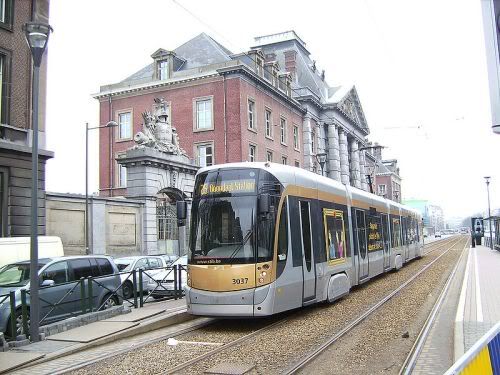
Trams and cars, living together on a city street
The picture above, from my earlier post, shows a perfectly valid and elegant real life example of a road that has a similar urban density found in the IV/Gore area.
In-ground two-way LRT tracks and two-way car lanes can co-exist with each other, while simultaneously allowing for alternate-side - time-of-day/week curbside parking. This example also allows switching the one and two car lanes in-between the north and south sides of the road on a time-of-day basis, if directional densities need to be accommodated during peak hours.
The concerns put forward in support of the decision to reject the LRT from the IV/Gore area included: the fear of losing curbside parking; loss of business during construction; and congestion!!
The kind of urban growth and its resulting economic benefits that we all desire so much is a direct result of urban density and not suburban density in urban settings.
Unfortunately the majority, if not all, from the two BIAs and their executives do not live in the heart of the core.
The bipolarity of our core springs partly from urban issues that continue to be defined and driven by suburban mindsets.
I can only suggest to those that continue to express frivolous concerns such as above, that you do spend some serious time investigating this with an open mind and a positive attitude, before making unilateral judgments on behalf of others.
There are many positive real life urban solutions from all over the world, many of which can be easily applied in the IV/Gore context, without traumatizing so many in our community with redundant approaches and preferences.
Hamilton's planning and economic growth problems are not unique; its parochialism is.
The bipolarity of our core springs partly from this debilitating human condition. Focusing on eradicating parochialism from our midst is critical to our collective economic and cultural success. It is the best legacy that you can leave behind.
Embrace true diversity and harness the local talent of hundreds of truly talented young and middle-aged professionals who have already moved into the core. It is about their future that we are talking about here. Many of you may not be here to see the LRT roll by. So leave legacies wisely which permits others following you to celebrate your efforts and not desecrate them.
Planning is about their future and not ours.
Our concerns should be focused more on fundamental issues such as sustainable financing and operational costs of the LRT; and we should be doing our best to ensure that all other conditions that make for an economic success, are in place – for the LRT's benefits to spread through the entire city.
By saying Not in our front yard - but our back yard is okay, you are essentially asking for Main Street to be turned into not just your back yard but our city’s backyard.
Intensification of the King Street East carriageway via LRT and two-way conversion, will add the much-needed urban scale and character to an already rich canvas, while bringing the critical body heat that is required to look, feel and perform as an truly international urban village.
Forcing the hand of the City to move the B-Line onto Main Street would in all probability result in the creation of a super transportation artery in our core. Architectural ugliness is all that can result from this move, with its corresponding near fatal other side of the tracks syndrome.
We simply cannot afford to divide the lower city laterally into two halves by a Main Street transportation artery – our kids will never forgive us for that!
It is imperative that we reduce the scale of our downtown core fast for economic activities to flourish. As in most urban examples, the LRT can be absorbed seamlessly into the renewed bustle of street life on the IV/Gore axis.
For Main Street to be revitalized, it needs to be humanized in scale via a majestic two-way boulevard with tall trees and landscape features, and ample room for the worlds most unique trans-Hamilton bike lane connecting the East and West ends of our city.
Celebrating true urban villages, unlike the IV/Gore area, is about focusing on the our collective achievements and aspirations; while allowing the multi-tasking, networked generation (that already is, or will soon, be living, working and playing in the core) – the grace to define their world.
Be it pedestrianization, high densities or yet undiscovered mixed-uses and economic activities, our NEXT is rightfully their call. It never was our call to begin with. Our efforts to date simply do not measure up.
We may be perfectly happy playing urban with suburban sensibilities, or even parading our preferences in place of promoting the multi-coloured lives and talents, that we are so lucky to already have in our core - but we must remember that our preferences are nothing more than cynical expressions of sycophancy and pathetic marketing plugs.
Just like the simple removal of bump-outs from our sidewalks, if we can quickly get rid of our parochialism we may actually being to accrue the benefits of the LRT before its arrival.
By jason (registered) | Posted January 25, 2010 at 09:29:16
great piece Mahesh. I have been somewhat surprised at a few things in this whole discussion:
A couple of options that I've thought of would be:
have the LRT run in mixed traffic through the short stretch between Wellington and Catharine like in your photo shown above. The traffic signals at both Catharine and Wellington should be set so that the LRT has queue-jumping privileges into this short mixed traffic segment. I've heard people dismiss this idea because of the current level of traffic congestion through there would result in slowing down the trains. Remember, Main and King will be two-way. Anyone looking to just bomb through town in their car will NOT be doing it on King St anymore. The majority of traffic in the IV will be local traffic that actually wants to be there. Car addicted Hamiltonians will always find the quickest, shortest way to their destination and with the two-way conversion, those routes will included Cannon, Wilson and Main. Not King.
Another option is to leave King one-way westbound in this stretch with one car lane, one LRT lane and parking remaining. The other LRT line could use King William for this stretch.
Finally, LRT could be removed off of King altogether at this location and run along King William with a stop at Ferguson, before running back to King via Catharine and/or Mary.
There are plenty of options for LRT to exist in this neighbourhood and I agree with you that folks from the suburbs shouldn't be charged with making these decisions. How hard is it to think of a few alternatives such as the ones I've presented above. I'm not suggesting they are the best options. I'm sure other readers will have different ideas, but the point is, the public has only been told that the BIA's and one pawn shop owner don't want LRT on King. If the BIA's presented 20 pages of great alternatives, they need to get those ideas publicized. After all, they are the ones who will benefit the most from LRT (although I must state that I've never seen a study outlining the impacts of LRT on pawn shops, so I can't speak with authority on that issue).
Comment edited by administrator Ryan on 2010-01-25 08:32:58
By realitycheck (anonymous) | Posted January 25, 2010 at 09:29:56
Mr. Butani wrote "The picture above, from my earlier post, shows a perfectly valid and elegant real life example of a road that has a similar urban density found in the IV/Gore area.
In-ground two-way LRT tracks and two-way car lanes can co-exist with each other, while simultaneously allowing for alternate-side - time-of-day/week curbside parking. This example also allows switching the one and two car lanes in-between the north and south sides of the road on a time-of-day basis, if directional densities need to be accommodated during peak hours."
The photograph posted is indeed a fine example of a streetcar route where lanes are shared with the streetcar and automobiles. However, this is not how Metrolinx envisions LRT in Hamilton. Metrolinx' transit vision is to develop rapid transit lines, not streetcar lines. The B-Line LRT is not intended to be a shared streetcar route but a dedicated rapid transit route, either as BRT in dedicated lanes or LRT on dedicated tracks. If Metrolinx approves LRT for Hamilton, the rails will be designed for LRT exclusively and will not accomodate automobile traffic. It may be possible to hybridize the route to a shared traffic format throughout the downtown should it run on King Street, but this will seriously compromise the relaibiltiy of rapid service on the B-line as trains in shared lanes will be subject to traffic bottlenecks. Anyone who endures a ride on the King Streetcar route in Toronto can attest to this fact.
Comparitively speaking, Main Street has a width that will easily accomodate dedicated LRT lanes in both directions, as well as two lanes for two-way automobile traffic and an additional lane of bumpout parking. In such a format, King Street can also be converted back to two-way traffic. Why is this much more preferrable traffic design being completely ignored? I will be pressing my city councillor to include this option in the traffic engineering study, and invite others to do so as well.
By race_to_the_bottom (anonymous) | Posted January 25, 2010 at 09:31:00
BRAVO! About time someone calls out the Emperors-With-No-Clothes running the Downtown core (into the ground). It's time for the Drewitts and Pociuses to step aside and make room for some new blood. No more stuck in old outmoded ways of thought - srsly angle parking on the south leg of King? what's the matter with these people?? - and pave the way for the renaissance this city NEEDS. LRT is WIN, but the business leaders seem to have gotten comfortable with FAIL.
By jason (registered) | Posted January 25, 2010 at 09:31:20
hey Ryan, not sure how to fix my wonky formatting above. When I edit the comment it shows up as being numbered 1-4, yet the comment actually appears as you see it.
By jason (registered) | Posted January 25, 2010 at 09:43:07
thank you editor in chief!
By schmadrian (registered) | Posted January 25, 2010 at 09:45:59
In an effort to put my money where my Hamiltonian mouth is, I spent considerable time this past weekend expanding my horizons.
Trying to understand my city better. Moreover, trying to understand the issues better...at least the ones I don't understand as well as I do others. LOL
The grand jewel in my explorations...second to going through back-posts of 'The Hamiltonian'...was discovering Mr. Butani. (Not that my first true exposure to his thoughts and his style of expressing them was a positive one. Grr...)
So my 'comment' is to thank Mr. Butani for being a source not only of information, but of informed opinion, well-qualified insight...and refreshingly stalwart contributions to the ongoing dialogue about Hamilton, specifically Downtown Hamilton. I'm grateful for having my perspective broadened, and for being nudged to apply my own cognitive energies to more demanding exercises.
This novitiate thanks you.
By jason (registered) | Posted January 25, 2010 at 10:00:20
I prefer King St for a few reasons:
Potential exists for small neighbourhood nodes all along King such as one would find along Queen East or Bloor West in Toronto. King and Delta, King and Sherman, King and Wentworth, IV, Gore Park, King/Hess, King/Locke etc..... all could become hubs of pedestrian-oriented retail, markets, dining, cafes that help rejuvenate the neighbourhoods. The building stock and streetwall all provide the foundation for this type of vision to be built on. I'm sorry, but Main and Wentworth or Main and Ferugson will never have the cozy, urban feel that King and Sherman or King and Wentworth or King through the IV could/does have.
For example:
http://www.flickr.com/photos/35765287@N02/3387345530/ http://www.flickr.com/photos/virgomerry/... http://www.flickr.com/photos/christopher...
Comment edited by jason on 2010-01-25 09:06:17
By John Neary (registered) | Posted January 25, 2010 at 10:34:16
Anyone looking to just bomb through town in their car will NOT be doing it on King St anymore. The majority of traffic in the IV will be local traffic that actually wants to be there. Car addicted Hamiltonians will always find the quickest, shortest way to their destination and with the two-way conversion, those routes will included Cannon, Wilson and Main. Not King.
I really, really don't want to come across as another guy griping about some petty inconvenience related to LRT and ignoring the promised benefits. I strongly support the project on a number of grounds: environmental, economic, quality of life ...
But I have seen a number of comments from time to time putting forward the idea that converting Main and King to two-way won't really affect car travel times because all of the traffic will switch to Wilson and Cannon.
Well, that's just great for the tens of thousands of people who live near those streets, which are presently even more of an urban blight than Main and King. At least the latter streets already have decent bus service, not to mention the lingering benefits of having been thriving commercial corridors before the Kool-Aid-drinking 1950s council decided to turn them into urban racetracks.
The city's consultants have already recommended that the proposed two-way conversion of Wilson should be put on hold if Main and King are converted to two-way as part of the LRT project. Meanwhile, the probability of Cannon becoming a human-friendly street anytime in the near future is somewhere between zero and nothing.
Barring gross incompetence or corruption in its design and implementation, I will support LRT. It is good for the city as a whole. But it would be a great shame if LRT is implemented in such a way as to encourage people to "bomb through" our most injured neighbourhoods even more than they already do.
(By the way, Jason, I feel like I have been picking on you in recent threads. I don't know why. I agree with about 95% of your posts. I think you just used a phrase that touched a nerve, and I don't intend this riposte to be personal.)
By TreyS (registered) | Posted January 25, 2010 at 10:53:38
I prefer Main route
@ Jason your second point that King has better retail and restaurants. It's true it does But won't the LRT on Main seed new developments so that eventually there could be some retail and destinations developed along the LRT line. And Main won't be so dreary. Main needs more help then King. ' Also Main/Queenston (highway 8) is a more direct route connecting the east and west ends of the city. King meanders along in the east through mainly residential neighbourhoods. And it's almost too south to service the center of the city. Main is the middle and can service both Barton and King St areas.
By jason (registered) | Posted January 25, 2010 at 12:56:50
John Neary, great post and no need to apologize. I haven't felt 'picked on'. Lol. As I said in my original post, I'm merely putting forth some thoughtful ideas but I know others will have some different views that are equally thought out. That's the beauty of good civic discourse - something that is completely foreign in the age of talk radio and US 'news' networks that are nothing more than suit and tie versions of the Jerry Springer show. Actually, he wore a suit and tie too didn't he? Anyhow.....
From what I've seen there are plans for two-way bike routes on both Wilson and Cannon in the near future (or perhaps as long as 25 years if council continues to puddle-jump with our bike plan) by removing a traffic lane while leaving street parking on the opposite curb. That would leave 2 lanes of auto traffic on these streets with both sidewalks buffered by cars/bikes.
Heck, maybe we'll even see the York Blvd two-way conversion spread further east along Wilson/Cannon.
Main will certainly become the dominant 'car' street in this plan with a full 2 lanes each way through the entire city and even room for turning lanes at major intersections.
Main could use help, but I'd prefer to see King become a bustling vibrant street like Queen, Bloor, King etc... in Toronto. The old building stock is already there. I'd much prefer an old streetwall to be restored instead of expecting our developers to build an equally great new streetwall on Main.
Remember, this is Hamilton - fences are now considered great streetwalls.
http://www.raisethehammer.org/blog/1578
Ultimately, I think Ryan's comment will prove to ring true - a properly planned LRT tapping into new riders will result in overall LESS cars on all of these streets.
Cheers
By UrbanRenaissance (registered) | Posted January 25, 2010 at 13:13:39
Maybe we should just let some slime mould plan it.
By Mahesh_P_Butani (registered) - website | Posted January 25, 2010 at 13:42:20
realitycheck >> "Main Street has a width that will easily accommodate dedicated LRT lanes in both directions, as well as two lanes for two-way automobile traffic and an additional lane of bumpout parking. In such a format, King Street can also be converted back to two-way traffic. Why is this much more preferable traffic design being completely ignored?"
Although Main Street has an extra lane – it also has a deeply disturbed memory of being (ab)used as an inner-city Highway.
Like human beings have memory – so does materials, artifacts, buildings, including streets.
Like metals and plastics that bends back to its original form, streets too often force themselves back to their original form and intent – in spite of our best intentions to shape them to meet changed needs of a new generation.
This is a very simple design/planning principle that has been ignored in our times - from which most of our modern urban design tragedies have originated.
Our Main Street's -disturbed memory- will force (some of us who are unaware of this principle) to continue to make us look at it in a way that will help -it- to perpetuate -its- existing dysfunctionality.
Although the previous generations may take full responsibility for the resulting blithe from Main which helped destroy our micro-economy for decades; and although they may try to correct it – their past actions have been embedded into the memory of the street.
Strange as it may sound, its wider carriageway is not an asset – it was the cause of our downfall for decades. And if we are lured or seduced into looking at it as an asset to justify laying the LRT tracks there – we will only be perpetuating our blithe for a longer time.
New York City is primarily composed of inner city highways – they call it Avenues. Their consistency made them the financial capital of the world, and in turn they gave the world a city that every one wanted to get a bite off.
We tried it in our past; we are incapable of being New Yorkers. We don't talk that talk, we don't walk that walk. Our Main Street and York Blvd are mere remnants of an experiment to become what we were not.
In the process, we lost an opportunity to create our own identity – the quintessential Hamilton persona – that of a small BIG town with a swagger, and a history that is as compelling as that of New York – if we had only believed in it hard enough.
Our original road patterns were a natural fit for developing a near perfect European town in North America. Instead we pursued the dreams of the big city – without the sensibilities that goes with such an undertaking.
In trying to make sense of our proposed LRT routes, we must first acknowledge that streets too have memory. And this memory forces use and form that -it- is familiar with, in spite of our best intentions to re-form it.
An exercise in taming the Main would involve visualization – intense collective visualization – of how we all see the Main of the past, its present and its future.
This just may help in erasing the streets acquired intelligence – through its recent memory of (ab)use, and if this succeeds, it may point us in the direction of what it always wanted to be.
University planners over decades tried to fight the pesky diagonal foot paths cut by students traversing the shortest possible routes thru pristine lawns – until one day someone got wiser and said, let us lay the lawns after the students have etched out their routes. All were happy after that.
The IV/Gore offer that organic etching - without expensive consultations.
Our preferences refuse to take simple etchings like this into account, because it is the perceived increase in real estate values under the guise of triggering renaissance on the Main – that is driving our choices. Not much has really changed since the days of laying the original tracks across Canada!
We need to dig deeper into our streets memories to find out what our street have been trying to tell us for so long.
Failing which, we will be back where we started in the seventies, only this time instead of two tracks; we will have three tracks to cross over – on our way to the waterfront from the escarpment.
By crhayes (registered) - website | Posted January 25, 2010 at 14:07:48
Maybe we should just let some slime mould plan it.
That's amazing! We can learn a lot by looking at nature - this behaviour has been formed through natural selection over millions of years. It's easy to see why it's so efficient.
Comment edited by crhayes on 2010-01-25 13:09:29
By jason (registered) | Posted January 25, 2010 at 14:36:36
Mahesh, you're on fire! Great writing as of late. Keep up the great work. It's nice to know that downtown has some sharp minds like yours who are willing to learn from past mistakes instead of just repeating them or trying band-aid solutions to cover them up.
By michaelcumming (registered) - website | Posted January 25, 2010 at 14:59:45
I think if the LRT goes through the International Village, then it has to share the road with any other traffic on it as Mahesh's photos shows. If this is not the case then clearly there is not enough room for it on this section of King St. In Europe where rail lines snake through dense downtown streets a considerable amount of design and attention is required to prevent cars and people from being run over by trains (for instance, as they talk on their cell phones). The implementation details are as important as the overall design concept.
By zookeeper (registered) | Posted January 25, 2010 at 15:11:35
^ Don't take the bait, folks. Lame troll is lame.
By jason (registered) | Posted January 25, 2010 at 15:54:33
LOL. zookeeper you rock.
By John Neary (registered) | Posted January 25, 2010 at 16:29:55
I have seen a number of comments from time to time putting forward the idea that converting Main and King to two-way won't really affect car travel times because all of the traffic will switch to Wilson and Cannon.
The evidence tells us that's not what happens. Instead, a lot of the traffic simply disappears.
Ryan, if you're arguing that travel times by car will increase, I agree. If you're arguing that traffic won't increase on parallel streets, I don't think the reference from Jane Jacobs supports your claim:
[W]hen a road is closed, an average of 20% of the traffic it carries seems to vanish. In some cases they studied, as much as 60% of the traffic vanished.
(Jane Jacobs, _Dark Age Ahead_, 2004, p. 75)
In other words, an average of 80% of the traffic does not vanish. So if King St. is closed to automotive traffic between Wellington and Mary, then we should expect 80% of the traffic to move elsewhere. Converting Main St. to two-way will not increase overall traffic flow -- it will decrease it. (And I fully support that!) Therefore, I take this quote to imply that we will indeed see an increase in traffic on parallel streets, which in practice means Cannon.
Again, I do not want to rain on the LRT parade. But there are powerful interests that oppose LRT, and I would not be surprised if compromises have to be made in order to make sure the project goes through. One scenario that seems entirely plausible is:
I don't think anyone on this board is advocating that outcome (or anything of the sort), but I remain concerned. Especially with city consultants recommending that Wilson not be converted to two-way.
Other than the concerns raised above, I agree that King is a better route than Main for LRT. It wouldn't take much work for King St. to look beautiful. And I think the everyday experience of the average person using the LRT would probably be more positive on King than on Main. The King William idea is interesting but it would slow the trains down and rob passengers of what could be a beautiful part of a daily commute. Besides, if the LRT returned to King on Mary St., it would be at risk of being crushed by collapsing theatres.
@TreyS, I believe the plans all involve LRT on Queenston east of the Delta. The King/Main debate, AFAIK, concerns the portion of the line between the 403 and the Delta.
On a lighter note, if the "Downtown Hamilton" gate needs to be torn down to accommodate light rail on King, can it be dumped in the harbour on top of the ruins of the old City Hall? I think that would achieve some kind of poetic justice.
By jason (registered) | Posted January 25, 2010 at 18:44:19
wrong thread
Comment edited by jason on 2010-01-25 17:45:01
There's been some discussion about where the East-West traffic will go if the LRT takes up two lanes and Main and King are no longer high-speed, multi-lane expressways. I expect that much of the traffic will simply go to the 403/QEW and the Link.
Any time I want to get to Centennial from Westdale, I have to face the same question: Main St or the 403/QEW? And I know from repeated experiments that they take pretty much the same amount of time. I take the highways if I'm in a bit of a hurray and the city streets if I don't feel like highway driving. Or, more and more often these days, I take Barton or Burlington because they are much more interesting, if longer, routes.
Which is all to say, we will do quite well without mid-town expressway given that we have convenient highways ... and besides, we might just come to enjoy a slow ride through a lively downtown some day.
Comment edited by moylek on 2010-01-25 20:03:55
By The Sage (registered) - website | Posted January 25, 2010 at 21:14:23
The aptly titled Bi-Polarity of the Core should be made required reading for the BIA's, the Downtown Non-Renewal Department, and academics who are studying the SNAFU that has come to represent Hamilton's chaotic demolition-by-neglect downtown policies.
Mr.Butani should be conferred the title of Professor for his recognized ability to analyse this complex paradigmatical "wicked" problem of Hamilton's Downtown and offer solutions that push the boundaries of public policy, planning, and development.
What is particularly irksome, and what would demand a review by the City of how the BIA does business, is Mr. Butani's revelation that the BIA did not engage its members in a consultation and dialogue prior to representing an official position on LRT to the City. This is unforgiveable in an era where it is only through collaboration and public consultation that the best outcomes are achieved.
By Mahesh_P_Butani (registered) - website | Posted January 26, 2010 at 09:34:06
Hello Jason, schmadrian, realitycheck, race_to_the_bottom Sage, and all: Thank you for your feedback and kind words!
By Really? (registered) | Posted January 26, 2010 at 15:51:32
Great Post/Read! Really makes one think.
I'm still oficially supportive of Main St as my preferred LRT route, although aslong as it's built, I don't care all that much.
I really enjoyed your vision for Main Street sans-LRT, but still think it's the best option for: a) Cost Factors (straighter route = less track), b) Attracting New Riders (faster route), and maybe most importantly, c) Getting COMPLETE Public Support (King St seems to be a hot-button)
I also believe King Street would benefit from a Main St route regardless, as LRT is still going to attract a new, diverse group of citizens looking for better transit options, and as is mentioned over and over again, King Street currently has a fantastic streetwall along most of it's stretch which will surely fill up with stores, easteries & services!
By jason (registered) | Posted January 26, 2010 at 16:48:04
King st only seems like a hot button because the media has made it out to be one. Rest assured, if the tracks were proposed to go on Main St, Main would be the current hot button.
By M.P.B. (anonymous) | Posted January 26, 2010 at 21:46:49
>>> Adam S:
I know I am "feeding" you with this. This in itself is an act of mercy and economical development at the same time!
You may well ask, how so? Here is how.
When you are well fed, you will be able to overcome your feeling of despondency and work your way out of the self-defeating cycle that you have put yourself in - whatever your addictions may have been.
With the hunger gone, there is a good chance for the restoration of self-esteem - and thus you naturally will be in a better state than you are in presently, thereby increasing your odds of getting involved in some productive activities - such as maybe suggesting new things that you have not already proposed here for a while now - or even maybe becoming the creator of the new economy itself.
This does take one more person off the mercy train. See the connections between mercy and EcDev.
Of course there is always the danger of you getting addicted to my act of mercy, and spiraling out of control. But that is chance I must take, least I be accused of denying you the basic courtesy in the state that you are in. Unless of course you tell me to stop feeding you, on your own accord - which then becomes your call. Which then interestingly enough -- leaves me free to go and figure out way to cut taxes.
But, your call never comes. You keep seeking food.
Now you see, why there is no good way of breaking this cycle of dependency between mercy and EcDev.
Your beef that others who are showing similar symptoms like yours do not deserve any act of mercy - is well founded - considering that many appear to you in the state that you are in presently, to be abusing the system. And the system itself appears to you to have taken on the appearance of a multi-national corporation. - This I concede can be a real and present danger.
And that is why, now that you are well fed - I am looking up to you to suggest some 'out-of-the-box methods and processes' that - you have not already suggested here - that address your concerns.
You do know I have a limited budget and really cannot keep up with this act of mercy for too long without increasing the taxes.
So it is in our mutual interest that you very soon come up with your 'out-of-the-box methods and processes' to create the new economy - which I am confident will result in a flood of high paying jobs in the core, which in turn will create the basis for reducing the taxes.
PS: Now, if you are still hungry, don't be ashamed to ask. It is just that when you snatch things away - like you have been prone to here, for a long time now - it get to be so counter-productive.
And btw what is it with this lefty thing you talk about?? or even this 'burbs subsidizing the LRT' now??? Is this some new kind of a racial or a class slur or something?
By jason (registered) | Posted January 26, 2010 at 22:20:44
I love how LRT lovers have never give a single reason as to why more people will want to live and shop downtown, just because of some shiny new trolley cars.
I love how you can write endlessly online, but apparently can't read:
http://hamiltonlightrail.com/ http://www.lightrailnow.org/index.htm http://www.todadvocate.com/index.html
By jason (registered) | Posted January 26, 2010 at 22:23:19
I also love how I can't format worth a crap.
By A Smith (anonymous) | Posted January 27, 2010 at 01:11:52
MPB >> I am looking up to you to suggest some 'out-of-the-box methods and processes' that - you have not already suggested here - that address your concerns.
Well, thank you for asking. According to the Hamilton's 2009 budget, "Planning and Economic Development" spending totaled $16.5M by the end of 2008. In contrast, "Community Services" was $159.6M and that doesn't include the $41.2M for transit, which is a basically a subsidy aimed at helping poor people. What this means is that the City of Hamilton is currently spending 12.5X more money subsidizing the poor than it is on trying to create new wealth and prosperity.
Therefore, what I am suggesting is that these two numbers be brought closer together. Shift away from spending money on poverty programs to investing in wealth creation and added value jobs. The fact is, focusing only $16.5M out of a total budget of $711M on growing the economy (2.3% of budget), while we spend 200.6M (28.2% of budget) focusing on creating services for the poor has not done one thing to alleviate poverty in this city.
Our focus is aimed so tightly on the issue of poverty (a bad thing), we have forgotten to look at where we want to go. Don't they say that when driving a car the best thing to do is to look at where you want to go, rather than where you don't want to? Can we say that about Hamilton today? I don't think so.
If Hamilton wants to cure its deficit of wealth creation and good jobs for every citizen, that needs to become our new focus, not expanding poverty programs like subsidized transit. Less money for poverty programs and more money for wealth and job creation.
By M.P.B. (anonymous) | Posted January 27, 2010 at 01:40:40
Well, that does make sense, Adam.
Hamilton does need its deficit of wealth creation cured. So how do you propose bringing these two numbers closer together.
I mean in real terms and not conceptually.
Also assuming for the sake of argument that all modes of transit are in fact subsidized. (You may or may not agree with me that cars and planes are subsidized too - or as some call it bailed out), how does one ascribe fair values to what is subsidized and what isn't?
By A Smith (anonymous) | Posted January 27, 2010 at 03:40:05
MPB, I think as long as the city looks towards where we want to go, rather than what we see around us today, spending decisions can be made that are both smart and compassionate.
However, even your question is filled with doubt about whether or not Hamilton can eliminate poverty without having people suffer. I understand this, but you have to stop thinking like this. Instead, imagine a scenario where employers are rushing to set up businesses in our downtown. Imagine the Hamilton Spectator filled with Help Wanted ads offering bonuses for people who will stay more than three months.
Imagine a downtown Hamilton where the transit, is profitable, extensive and actually needed because of the volume of people that work and shop downtown. Imagine a Hamilton where people of all ages and abilities work at a challenging job, earn their own income and can enjoy dinner across from a Gore Park filled not with sadness, but with optimism.
That's what will take place once we shift our focus to creating good jobs and new industries.
By M.P.B. (anonymous) | Posted January 27, 2010 at 05:14:53
Adam, You are correct, it is about *intense imagination*.
I presume, when you say city, you do also mean not just the folks in the city hall, but our entire city.
My question is filled with doubt- because the healing process has yet to start. We are just beginning to acknowledge the damage to our collective memory.
> [...] If you ask "Why is Thekla's construction taking such a
> long time?" the inhabitants continue hoisting sacks,
> lowering leaded strings, moving long bruses up and down,
> as they answer "So that it's destruction cannot begin."
> And if asked whether they fear that, once the scaffoldings
> are removed, the city may begin to crumble and fall to
> pieces, they add hastily, in a whisper, "Not only the
> city."[...] *Italo Calvino ~ Invisible Cities*
By Mahesh_P_Butani (registered) - website | Posted January 27, 2010 at 05:29:33
- Really? "I'm still officially supportive of Main St as my preferred LRT route, although as long as it's built, I don't care all that much."
Dedicated LRT tracks on Main could end up like this in spite of the best assurances: - since speed will be the key driver according to (realitycheck) who says - "Metrolinx' transit vision is to develop rapid transit lines, not streetcar lines. The B-Line LRT is not intended to be a shared streetcar route but a dedicated rapid transit route..."
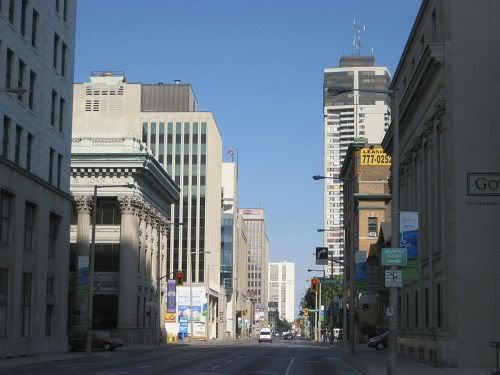
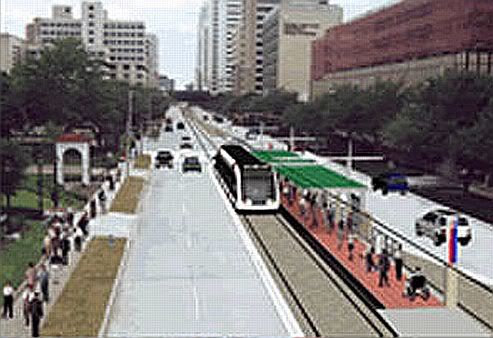
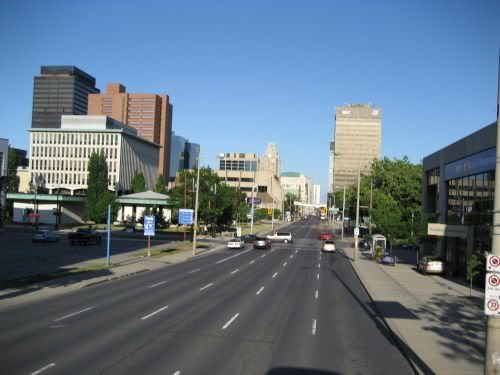
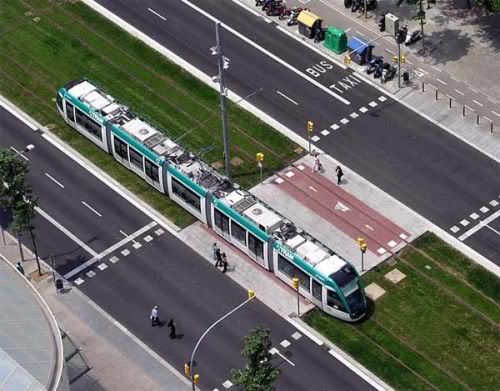
If we are lucky - Main could end up looking like this:
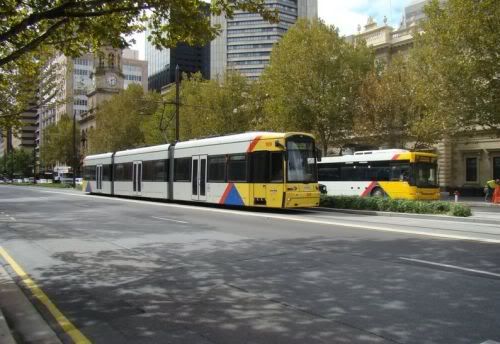
Main once did look like this:
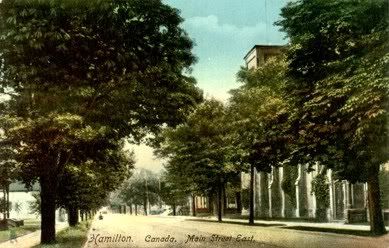
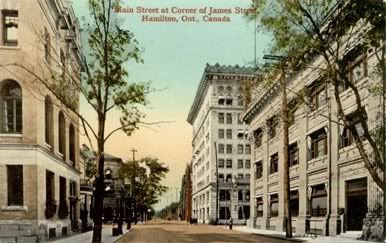
LRT on King always looked like this:
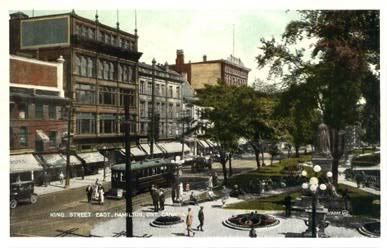
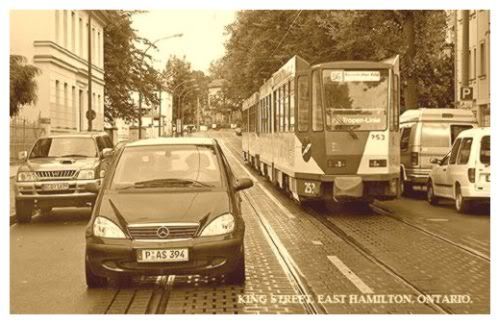
Main could also begin to look like this, if we stop asking it to be our backyard...
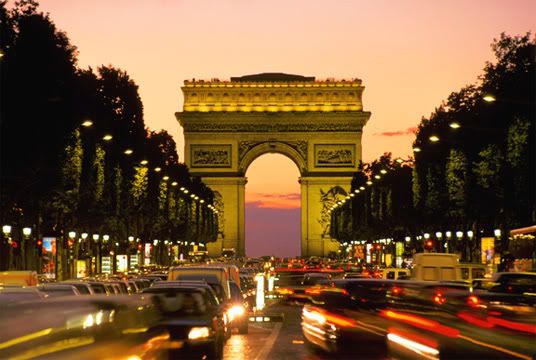
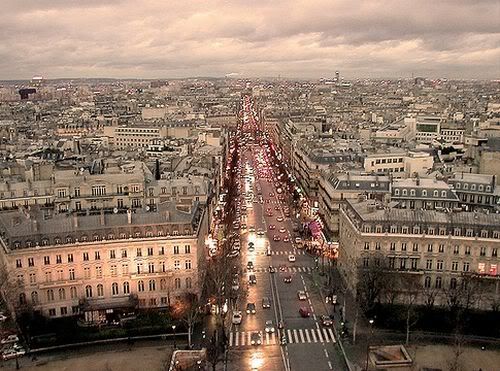
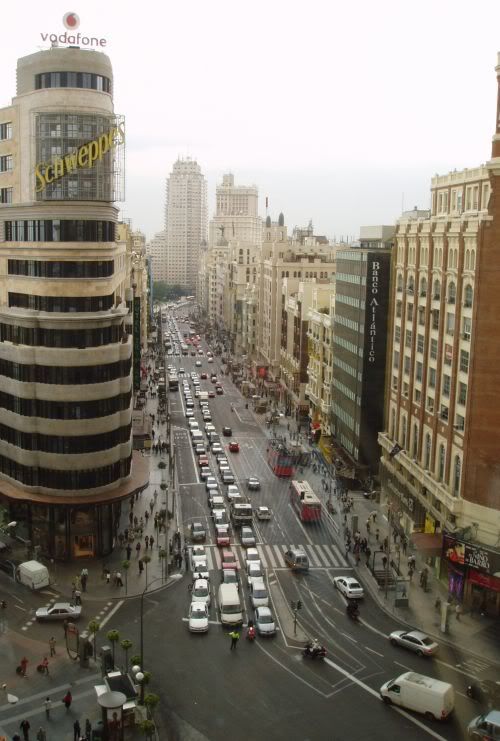
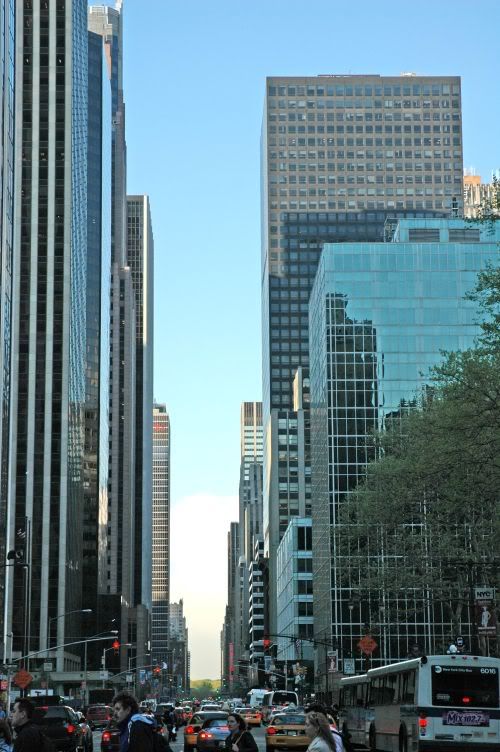 ...and instead ask it to be the Grand Avenue of Dreams... to our new economy!
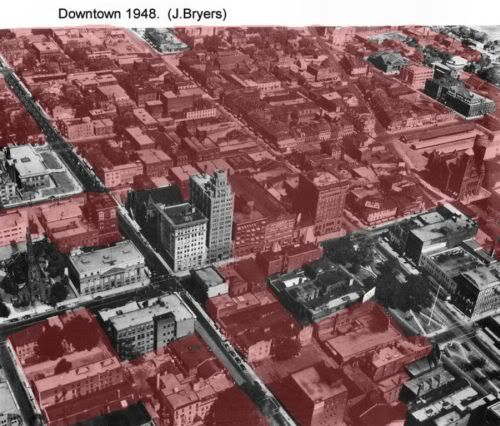
But then, how do we get there? When we are afraid to learn from our past... (destroyed history highlighted).
This is how the Romans treated their roads back in 312 BC. It just wasn't about looks - it was the strategy behind the Appian Way, that reversed their fortunes:
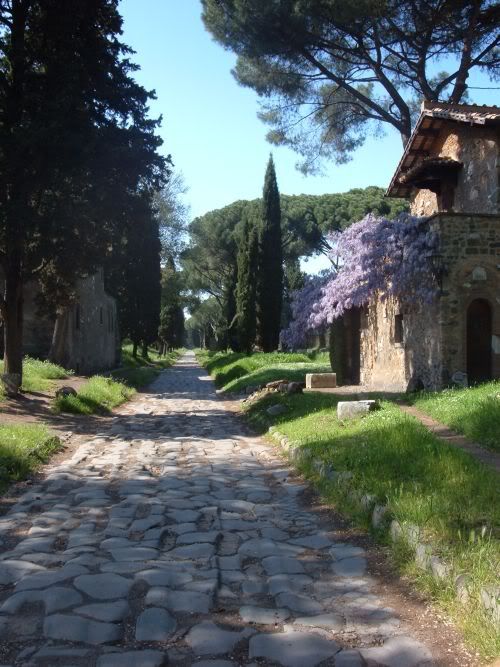
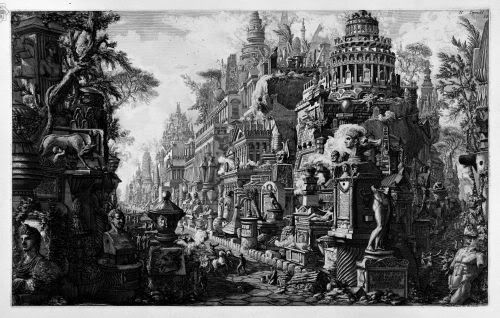
"Appian Way" as it appeared in Piranesi's imagination (1756).
Can we still afford not to care all that much?
By michaelcumming (registered) - website | Posted January 27, 2010 at 12:19:31
Hey Mahesh! You're rocking it! Thanks for the photos. Hamilton has to get beyond their sometimes inexplicably pessimistic perspective that these relatively straight-forward design exercises will always get out of hand and really work poorly in the end.
In current circumstances the past history in Hamilton of broken dreams and failed opportunities is perhaps not the best model to follow. I look forward to a prosperous, green future for Hamilton. Rational, evidence-based and creative urban design policies will help get us there.
By jason (registered) | Posted January 27, 2010 at 13:53:00
great stuff Mahesh.
I still can't figure out why Hamiltonians and our politicians can't learn from other cities. Especially these days where one can tour the world online.
Does nobody ever go out here? does nobody ever see the odd bit of video footage from bustling, vibrant cities all over the world? I mean how hard is it to go online and see great urban examples that we can learn from.
Heck, Hamilton has a massive Euro population. Does nobody ever go visit the motherland anymore???
By Mahesh_P_Butani (registered) - website | Posted January 27, 2010 at 20:26:13
Hello Jason,
Thank you!
I think in most instances, humans mimic the environment they finds themselves in.
There in lay Bill Stirckland's simple belief and his monumental success!!
Hamilton stopped being a learning city after successive fatal blows were struck at its architecture over the last fifty odd years (as highlighted in the downtown image above).
Loosing so much of a city's memory is bound to take a significant toll on its people. Loss of historical associations is in many ways worse than the loss of a local economy. It makes people regress, it takes their pride away. Often it replaces it with false pride and parochialism - resulting in our small-mindedness and even smaller turf wars - which have no big picture in sight.
The big pictures that existed was decimated. Who are we? Is the question people ask, when left on a blank - flat surface. Not finding an answer, they loose patience.
Even when the economic cycle turns around, human behavior rarely does. What is lost with the mindless destruction of memories is peoples ability to 'care' - and from that grows loss of curiosity, and the loss of ability to learn - from and of the past.
That is how we are - where we are on most days in Hamilton.
The failure of our educational institutions to recognize this is missed on most.
Their failure to engage with the city is not.
We have become a non-learning city in spite of the strong presence of our university and college.
From structural sciences to moral sciences to medical sciences - ten thousand years of technical authority based on research and knowledge could have been easily deployed by both - to put up a formidable challenge to prevent the destruction of our collective memory in the core. But in spite of both bragging world fame in engineering and the sciences and innovation - not one challenged the madness that allowed our city to become a non-learning city.
It is this kind of carelessness that casts the mould for our environment in Hamilton - in which successive generations have been formed to not care - not give a damn!
Edited by Architecture for Humanity, Design Like You Give a Damn is a compendium of innovative projects from around the world that demonstrate the power of design to improve lives. - It is also a call to action to anyone committed to building a better world.
This magnificent book shows us ways of thinking and getting inspired to reconnect with our broken memories - from which we may find ways of seeing, and doing that we have forgotten.
-- Hamilton schools should make this book a mandatory read, if we want to break the cycle of not giving a damn about our environment that feeds us our thoughts - which feeds our environment.
Cheers,
Mahesh
By highwater (registered) | Posted January 27, 2010 at 20:48:08
Best post evah!! And thanks for the heads up re the book!
By M.P.B. (anonymous) | Posted January 28, 2010 at 12:43:33
Thank you highwater - much appreciated!!
-Mahesh
By grassroots are the way forward (registered) | Posted January 28, 2010 at 13:53:30
The more I see the picture, the more I like it. If this types of rail went everywhere all over the city, less vehicles would be used. At least that is what I would think.
By Really? (registered) | Posted January 28, 2010 at 14:01:51
I received a reply from the City's Rapid Transit Office (http://www.hamilton.ca/ProjectsInitiatives/RapidTransit/) in regards to my opinions on B-Line Routing.
They pretty much stressed that King St is the only option they're studying, and despite my whole email being about a Main Street route, they didn't even mention Main once in the reply. "Rapid Transit Team is recommending two-way rapid transit on King Street with the introduction of two-way traffic within the same corridor."
That being said, I'm going to guess that King St will be the official route chosen for B-Line LRT. It's too bad there wasn't any public consultation on this.
If that's their choice, ok. I don't want to cause any delay in it's implementation so I'll fully support!
Why didn't they run the same study for Main St at the same time? I hope that after this King St Report is complete and (if) King is deemed no good that they wont spent another year studying a different route (ie: Main St)
By Jonathan Dalton (registered) | Posted January 29, 2010 at 08:48:46
In the first PIC they presented two alternatives for further study - King LRT with King/Main 2-way conversion, and Main/King split LRT with one way traffic retained. The latter is not much of an alternative - almost nobody supportive of LRT wants anything to do with one way streets. So the public input overwhelmingly favoured King St. LRT. If they had presented Main St. as the alternative the outcome would have been different.
By Walkman (anonymous) | Posted January 29, 2010 at 16:03:24
As an aside, can anyone, please, tell me the attraction of curb-side parking? Shopping malls don't provide them. I mean, I get the appeal of pulling up in front of the shop you intend to visit, dashing in and straight out again, but I've only ever seen it done in movies. In truly busy commercial areas there's never an empty parking spot directly outside the popular businesses. Personally I've always had to park at one end of Locke Street, for instance, or the other, and walk to the shops I like, often finding newer interesting places along the way, and acquaintances to talk to.
I mean, what kind of shop calls itself busy if it serves only one client at a time, each arriving by car? On King St. E. though, I usually find a spot in that attractive little lot at Jarvis(?) St., by the clock. It's handy to a number of locations I like to visit. So why do BIAs always whine about the need for curb-side parking? Looking at Mr. Butani's photo, I think wouldn't that parking lane be more attractive filled with pedestrians and cyclists than a parked car? What's the appeal of on-street parking, please?
By seancb (registered) - website | Posted January 30, 2010 at 16:18:46
One nice thing about on street parking is that it provides a buffer between pedestrians and traffic. Another is that it slows traffic down.
On the downside, it can be hell for cyclists, and it also uses valuable road space...
By highwater (registered) | Posted January 31, 2010 at 11:46:58
Also, if it's metered, and the price is sufficient to maintain a 15% vacancy rate, it allows people to stop and shop on impulse, usually on their way to or from work, which is why banning parking during rush hour is bad for businesses. I definitely sympathize with the IV merchants who don't want to lose the onstreet parking. And yes, as Sean states, it's a great buffer and traffic calmer. I believe it enhances the pedestrian friendliness of streets.
By Walkman (anonymous) | Posted February 01, 2010 at 13:24:14
Thanks for the info. Parking as a traffic calming device is something I hadn't thought about. I haven't personally experienced curb-side parking to be very efficient as an incentive for impulse shopping. Vacancies are too uncertain. But if short term spots were reserved for the front of attractively landscaped, off-street lots like the Jarvis St. lot in the IV, but at either end of the traffic flow, freeing up the parking lane for a designated bike, boarding, skating, electric-skooter lane, mightn't that serve all interests more efficiently?
Actually, upgrading the payment methods for parking is something that I'd value more. I like the solar powered parking-pass dispensers I find on Toronto streets, and some Hamilton parking lots. They allow me to use a number of ways of paying, important when I'm short of change, especially as I don't like carrying lots of loose change in my pockets. And these should allow something that I haven't seen tried anywhere, but might have some merit: selling monthly parking passes. I'm thinking something similar to monthly transit passes. Why not? They could be a visit-building incentive by providing discounts for frequent-useage. Further discounts could be offered to specific target groups served by specific businesses in the area, much the way bus passes encourage useage by seniors or students. These passes also offer the opportunity for data collection to focus business promotions toward users. For that matter, the payment stations could also be electronic kiosks carrying advertising for area shops. And when we think of parking, why do we only think of automobiles? I think secure parking for bikes, priced at nickles and dime rates, would offer similar benefits as incentivized off-street car parking.
Sorry. Hadn't planned to get into this when I made my initial query. It just to me to thinking.
You must be logged in to comment.
There are no upcoming events right now.
Why not post one?