Raise the Hammer

If you follow the rules of the road and ride carefully, cycling is actually much safer than driving.
By Ryan McGreal
Published September 09, 2007
Raise the Hammer promotes cycling as a great transportation choice. It's cleaner and healthier than driving, producing zero emissions and achieving the equivalent of 595 km/l (1,400 mpg) in fuel economy.
Nevertheless, would-be cyclists often ask: But is it safe? Will I have to pay for my environmental choice with crippling injuries or premature death?
An article in View Magazine a couple of months ago advocated for better bicycle infrastructure by focusing on cycling dangers. Though well-intentioned, it reinforced many preconceptions without examining them for accuracy.
In fact, cycling is arguably safer than driving.
Every activity carries risks, and are many possible ways to compare the relative risks of cycling and other activities. Looking at several can help to form a more complete picture.
The most obvious comparison is the fatality risk per distanced traveled. In this straight-up analysis, cycling is more dangerous than driving. Every 1.6 million kilometres (one million kilometres) cycled produces 0.039 cyclist fatalities, compared to 0.016 fatalities for motorists. They're both very low, but the risk for cycling is more than double.
However, this is not the most useful way to compare risks.
Failure Analysis Associates, Inc. performed a comparative analysis of fatality rates for a variety of activities per million hours spent performing a given activity. They concluded that the fatality rate for every million hours spent cycling is 0.26, compared to 0.47 per million driving hours (on-road motorcycling comes in at a whopping 8.80 deaths per million motorcycling hours).
That is, riding a motor vehicle has nearly twice the risk of fatality as riding a bike for a given duration.
According to the US National Safety Council, for every million cyclists in the US, 16.5 die each year, whereas for every million motorists, 19.9 die each year.
This is important, because it helps us to draw conclusions about how the higher risk per distance traveled interacts with the lower risk per time spent traveling. Cycling is more dangerous on a straight distance comparison, but because drivers travel farther on average, the overall risk to an individual is higher for drivers than for cyclists.
This is related to what we might call "commute homeostasis", or the amount of time a person is willing to spend traveling. All things being equal, a person is willing to travel a farther distance only if they can get there faster.
People who drive tend to live farther away from destinations (e.g. work commute) than people who cycle. In fact, one benefit of cycling is that it saves so much money that cyclists can often afford to live much closer to where they work.
Cycling also tends to place a premium on proximity, so cyclists are more likely to locate in places where many destinations are nearby, which reduces the cycling distance and hence the risk as a function of distance.
Another way of evaluating risk is to examine the odds of dying if you do crash. Common sense dictates that crashing in a bicycle has a higher risk of death than crashing in a motor vehicle, but according to the NHTSA, bicycles compare rather well.
The odds of dying from a bicycle crash are one in 71. This compares to one in 75 for a light truck (pickup truck, SUV, van), one in 108 for a car, one in 43 for a truck, one in 26 for a motorcycle, and one in 15 for a pedestrian.
In other words, the odds of dying in a bike crash are about the same as the odds of dying in an SUV crash. The false sense of security that comes from an SUV tends to produce far more dangerous driving behaviour.
Collision From Behind
Possibly the most feared collision among would-by cyclists is the collision from behind by a fast-moving car. This only makes sense: it's frightening because it seems unavoidable, because the novice cyclist feels powerless against a two-tonne projectile passing too closely.
However, such collisions make up only a small percentage of total bicycle crashes. According to a 2003 study in Toronto, collisions involving a motorist overtaking a bicycle accounted for only 11.9 percent of the total. Among those collisions, the cyclist contained minimal or minor injuries in nearly 90 percent of the incidents.
Ken Kifer provides some excellent advice on how to maximize your safety around passing vehicles.
In addition to the direct risk of death or injury, cycling and driving also carry indirect risks that must be factored into account.
According to a study by the British Medical Association, the average gain in "life years" through improved fitness from cycling exceeds the average loss in "life years" through cycling fatalities by a factor of 20 to 1.
Driving confers no commensurate health benefits through improved fitness; in fact, time spent driving actually correlates with poorer overall health and higher risk of heart disease, obesity, diabetes, cancer, and related lifestyle diseases.
Psychologically, it's hard to weigh the slight risk of being hit by a car tomorrow against the vastly reduced risk of having a heart attack in twenty years, but it is far too significant to ignore.
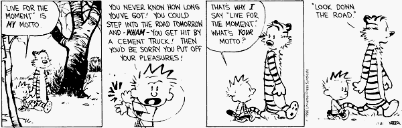
Since cyclists are not a homogeneous bunch, it makes sense to examine whether and how cycling behaviour affects fatality rates. It turns out that cyclists who ignore the rules are much more likely to die than cyclists who follow the rules.
The difference is so stark that it would make more sense to regard them as two separate populations for the sake of comparison. Averaging the two groups - cyclists who follow or who disregard the law - together obscures the vast differences in their relative risks.
It also obscures the fact that an individual cyclist's choices strongly influence their risk of fatality. Cyclists are not helpless victims of safety statistics (even encouraging statistics).
In many bicycle crashes, the cyclist is at least partially responsible. Cyclists are hit when they ride on the sidewalk and appear out of nowhere at intersections; when they pass on the right; when they ride at night without lights and reflectors; when they ride the wrong way down one way streets; when they ride too closely to parked cars; and so on.
Bike infrastructure can certainly help: streets with clearly marked, well-maintained bike lanes are safer than streets without them. It's also clear that bike lanes increase the perception of safety for would-be cyclists, which increases the number of cyclists on the road. That, in turn, makes cycling safer because drivers come to expect to share the road.
However, the way you ride is a big factor in accident prevention. The absolute best way to avoid accidents is to ride as though you are driving a motor vehicle. In other words: be visible, follow the rules of the road, pay close attention to what's happening around you, and practice defensive riding. You will earn the respect of motorists, maximize your safety, and get the most enjoyment from cycling.
By joejoe (anonymous) | Posted September 10, 2007 at 08:16:50
Here's the crucial point:
"Bike infrastructure can certainly help: streets with clearly marked, well-maintained bike lanes are safer than streets without them. It's also clear that bike lanes increase the perception of safety for would-be cyclists"
I wonder what the bike accident stats are in countries like Holland and Germany where dedicated bike lanes (i.e. lanes seperated by medians and not token white lines) separate the bikes from the road?
The fundamental problem, as I see it, is the way we mingle bikes and cars. Can you imagine how many more pedestrians would die if we all had to walk on the road?
Take a trip to Europe and go biking there. You will truly understand why cycling is so dangerous here.
Note also that our attitude to cycling is not just about the actual accident stats, it's about how dangerous cycling in North America makes us FEEL.
Ultimately the best way to encourage cycling (and I agree we should encourage it) is to design our road network to accomodate all modes of transport - and I don't mean 3 feet of sidewalk and token white lines that stop abruptly every few miles.
By Bradford Hovinen (anonymous) | Posted September 10, 2007 at 10:07:48
I'd agree that cycling in Europe feels much more pleasant than cycling in Canada or the United States, though I think that's more a result of the attitudes of motorists than of the cycling infrastructure. I find that motorists here treat me worse when I cycle carefully, in safety, and follow the rules of the road meticulously than when I don't (or, rather, didn't -- I always follow the rules of the road nowadays). This is because so many of them refuse to recognize cyclists as legitimate road users. My friends from Europe are appalled when they see what motorists here get away with doing. The kinds of behaviour I see every day here in Canada are simply not tolerated over there.
An all-out effort to change motorists' attitudes and behaviours -- and *really* hold them accountable for their driving -- would, in my view, do much more to make cycling safer and more enjoyable than installing bike infrastructure.
By joe joe (anonymous) | Posted September 10, 2007 at 12:21:58
Hi Bradford,
I agree that driving attitudes contribute towards the dangers of cycling, but you can't discount the affect of a decent infrastructure. It is harder to plough across a concrete median and hit a cyclist than it is a white line.
About your point on attitudes - how do you change these? One way is to promote cycling as a safe and efficient means of transport (the more drivers who bike the more empathy they will have...the more bikes on the road the more drivers will get used to them...), and one way to do this is to actually make it safer - by installing a decent infrastructure.
It's sort of a chicken and egg debate but in my mind the infrastructure piece is possibly the most critical starting point.
By Ted Mitchell (registered) | Posted September 10, 2007 at 14:14:46
Agree with joe joe: "It's sort of a chicken and egg debate but in my mind the infrastructure piece is possibly the most critical starting point."
You will note that the trolls on this website never use relevant counter-arguments, they simply use invective.
It is the same with discourteous drivers, they hate anyone who would take part of their road away, and that hate is amplified by way of their having a bigger weapon. Logic, courtesy, and rights do not show on their radar. If you haven't learned the golden rule by the time you can drive, you never will.
So you need to have more bikes on the road, and more bike infrastructure helps.
By joejoe (anonymous) | Posted September 10, 2007 at 15:15:38
Ryan,
I completely get the point of your article - it is well put together as usual. My counterpoint - addendum if you like - is that I believe many people don't bike because they don't FEEL safe. Whatever the stats tell them this is not going to do much to make them feel safer (statistically I have a negligible chance of dying on a plane but I still panic when it hits turbulance). Persuade our car friendly council to build European style thoroughfares and I'll hit the streets tomorrow.
Having said that you make many valid points. The perspective is useful.
By Bradford Hovinen (anonymous) | Posted September 10, 2007 at 17:04:42
On the question of changing attitudes, one suggestion I have made is to include safe cycling education on the level of CAN-BIKE 1 in public schools and (maybe more importantly) to include information on cyclists' rights in driver training. When I brought this up with the Toronto Cycling Committee, it was pointed out that they have been pushing for the same things, but the Toronto District School Board has stonewalled thus far.
As for those motorists who continue to disrespect law-abiding cyclists, I would suggest first making the harassment of law-abiding road users (by, e.g. honking one's horn) illegal and punishable by a stiff fine and demerit points.
Then, for heaven's sake, actually *enforce traffic laws*. Take a few cases, punish the people as severely as the legal system allows, and make sure everyone knows about it. Keep doing that until everyone gets the message. I heard about a recent case in Germany where the government put a person in prison for twenty years because he drove aggressively, causing an accident that killed a mother and her child. The authorities wanted to make an example of the motorist. That's what we need here.
As for infrastructure, I must say that my support for bike lanes has waned considerably in the last couple of years living in Toronto. The city does almost nothing to enforce them, so they become free parking for motorists. Cyclists are then forced to move around parked cars, which puts the less-experienced ones in grave danger as they are moving into and out of the flow of motor traffic. They also create hazards at intersections, since motorists usually turn right from a position to the left of the bike lane. In short, bike lanes don't obviate the need for education of both motorists and cyclists.
A few months ago, I brought up the idea of putting in a concrete divider to separate the bike lanes and prevent motorists from parking in them with a friend who works for Toronto city council. Since then, my support for the idea has fallen. They create problems for cyclists wishing to make vehicular-style left turns, they make the lanes much harder to keep clean, and, unless the lane is very wide, they make overtaking very difficult and potentially risky (some cyclists are extremely slow, and I ride at a pretty good clip, so I don't want to be perpetually stuck behind them).
So, in short, I lean more in favour of education and enforcement than of infrastructure.
By Councilwatch (anonymous) | Posted September 11, 2007 at 00:30:12
I will support cycling when cyclist adhere to the roads, stop for red lights instead of switching to pedestrian crossings and most important pay for and be compelled to have liability insurance (like motorists)for injury and loss of earnings to pedestrians. I speak from experience on the last one.
By Ryano (anonymous) | Posted September 11, 2007 at 06:45:25
Very good analysis of the risks measured by time vs by distance travelled. The life-years factor is well-known to me already, but this is also an excellent point that many people forget. I would however like to take issue with the fatality rate calculation. Your definition of "crash" is "crash with motor vehicle". While this is obviously a reasonable proxy in cities where cyclists are forced to ride on the road and "mix it" with the cars, but where (and when) that is no longer the case then the fatality rate of cycling falls significantly because a greater proportion of crashes are with fixed objects and other cyclists rather than (the more fatal) motor vehicle. This is in fact the case if you look at fatality statistics for countries where rates of bicycle use (and therefore provision by govts of safer roads and facilities for cyclists) are higher, such as Japan or the Netherlands. Your point about the law-abiding vs non-law abiding cyclists is valid, but the same can be said of drivers. The difference is that dangerous drivers pose immeasurably greater risks to others (and to more groups - passsengers, other drivers, cyclists, motorcyclists and pedestrians) whereas reckless cyclists are a danger mostly to themselves. That's not to say I don't get rankled when I see them bothering pedestrians, and occassionally even a pedestrian can get hurt or even fatally injured in an incident with a reckless cyclist, but the risk pales in comparison to the risk from motor-vehicles reckless or otherwise (don't even mention the numerous environmental issues, the noise and nuisance, the space, social issues, sprawl and all the other problems that cars can inflict on a society).
Other than these few quibbles, a very good piece. Well done!
Ryano (no relation)
carfreetokyo.blogspot.com/
By seancb (registered) - website | Posted September 11, 2007 at 11:22:29
Councilwatch, do you support driving? Despite the fact that almost all drivers disobey the rules of the road daily? http://youtube.com/watch?v=182F3KnT9Z4
I've said it before: enforcement needs to be more strict and more fair. I support enforcing traffic rules for bikes, but only once I can see that they are being enforced for drivers as well.
Ryan,
In the UK there are no STOP signs (that I know of). Instead you have 'Give Way' signs and roundabouts. To me these are much more sensible traffic management approaches.
Let's face it - one reason non of us stops when the intersection is clear (cyclists and drivers alike) is because most intersections can be safely navigated by simply slowing down, looking around and moving on. This is true for most motor vehicles which now have pretty good sight lines and it's triple-ly true for cyclists.
You can't expect compliance with a rule which is unnecessary cautious. It's all fine and good to be careful, but the approach has to be reasonable otherwise nobody will ever abide by it.
We know that STOP signs can actually CAUSE accidents too. Recall the horrendous crash just outside of Hamilton a couple of weeks back. With the All Way STOP designation drivers are sometimes inclined to rely too readily on their right of way without keeping their eyes on the other driver (not that I am suggesting that this is what happened in the Hamilton accident...we may never know). But I have seen this happen - and done it myself. In the UK, with the Give Way approach, drivers tend to be wary of their counterparts even when they clearly have the right of way.
I'm all for enforcement but the current STOP sign approach is just asking to be abused and you'll never enforce it effectively unless you have cops on every corner.
I guess this discussion is creating more debate than solutions?...!
Ben
By Ayatollah Usoe (anonymous) | Posted September 11, 2007 at 13:15:04
I agree with the comments that people don't FEEL safe cycling. Our mandatory helmet laws have convinced parents that cycling really is dangerous, and have tricked cyclists into believing that eight ounces of styrofoam makes them invincible. The truth is somewhere between.
The fact is, we don't hold motorists responsible. Note how rarely a motorist is charged in an accident with a bicyclist. Compare that to how a gun owner is charged when his gun has an "accident." We need to hold motorists to a higher standard of how they operate vehicles.
By Councilwatch (anonymous) | Posted September 11, 2007 at 13:25:24
Seancb I am the victim of an "accident" while legally on a crosswalk, where a cyclist seeing the light was red for him made a fast right turn onto a pedestrian way and struck me causing severe rib and sternum injury from which I lost eleven weeks work and earnings. My point is that cyclists should be compelled by the same laws which govern motorists and pay the same liability insurance. I agree that there are many irresponsible motorists but at least they "Pay for their stupidity".Ryan, a California roll is a violation whether there is tarffic or not and to continue with it will become a habit that could eventually result in a fatality. Be responsible!
That last point is key! (and yet it seems like such basic common sense...). We should enforce the laws based on the impact of breaking them. Otherwise all we do is collect fines.
I could harp on about how the police is set up as a business (have you noticed how police seem to target speeding motorists based on their ability to catch the largest volumes, rather than on the relative danger of the targetted stretch of road...?!) but that would be missing the point (but only a little - I'm sure cycling law enforcement is somewhat based on the same business revenue model...)
The point about cycling proficiency is spot on too. I am always amazed at how North American cyclists move into the road to go around a car without looking. Looking back before moving out is a basic manoeuvre (although it wasn't passed on to me by my parents, I just learned from watching other UK cyclists)
So some level of training/eductation and properly targetted enforcement seems to be the way ahead. Along with a decent infrastructure.
Maybe when we're done with that we can build some roundabouts so that I can stand around laughing while all the North Americans try to use them :)
By seancb (registered) - website | Posted September 11, 2007 at 13:56:23
Great points Ryan, particularly about how to focus enforcement. I also agree that improving cycling awareness is the most important step. This means educating cyclists about how to act in traffic and motorists about how to act near cyclists. In my opinion it also means doing whatever we can to increase the number of cyclists on the road.
Councilwatch, I am sad to hear about your experience. The collision in which you were unwittingly involved was definitely due to a lapse of judgement on behalf of the cyclist. We can only hope that in the cyclist's case, it was a momentary rare lapse and not a habitual one.
I do have to challenge your position however. Even though I know it struck close to home for you, one such experience does not automatically mean that it is a regular thing. And if that cyclist was in a car and made a similar lapse in judgement, it is unlikely you'd be here to tell the tale.
The reason there is no liability insurance requirement for cyclists is because major bike accidents like yours are a minuscule minority when compared to the accidents caused collectively by cars (where even a small "fender bender" can cause injuries similar to or worse than yours -- and huge property damage costs to boot).
As a side note to all of this, I think that the rules imposed on traffic when passing construction workers should apply when passing cyclists as well. That means reduced speeds and increased fines. Signage could be placed along all of the city's designated "safe cycling" routes.
By Observer (anonymous) | Posted September 11, 2007 at 17:34:42
Seancb..it seems that you are definitely hung up on protecting the irresponsibility and imaturity of all cyclists (of which I am one long experienced and club cyclist)while condemning all motorists for the mistakes of a few. Councilwatch is correct in asking the question "Why are we as cyclists not compelled to carry liability insurance?". It is available you know for responsible bikers. I spend my summers on cycling holidays all over the world and I can tell you that it is not accidents involving cyclists that I observe but the many, many accidents caused by cyclists who pedddle away unconcerned.It does take a drivers test to operate an automobile, anyone can ride a buke.The answer you gave Councilwatch was ridiculess and if this is your attitude to logical concernI will question your ability as a cyclist.
By sean (registered) | Posted September 11, 2007 at 22:53:31
Observer,
I have said it many times. I am arguing for BALANCED ENFORCEMENT of ALL ROAD USERS. I welcome you to stand on any city street with a radar gun and record the percentage of motorists obeying the speed limit. Stand at any stop sign and record the percentage of drivers coming to a complete stop. Or watch my video above and let me do the work for you. The sad truth is, every road user habitually breaks laws every time they leave the house. The difference is, those behind the wheel of a car are capable of causing great harm to those around them. If the rules are for everyone, that means everyone. So, in fact, I am not hung up on protecting immature cyclists. Are you hung up on protecting immature drivers? I AM hung up on demonstrating that the common attitude that "crazy cyclists" are the root of the problem is completely false.
Today, I was almost run over by a police car. I was coming to a stop along the curbside lane, and the police car turned left in front of me, driving in the wrong lane of two separate streets and almost hit me head on. Here I am, with my required lights and stopping at a stop sign and still I'm inches away from being flattened by a car. THIS is the kind of road behaviour that kills people. How many pedestrian deaths have we sufferred in this city this year? How many of those were caused by "crazy cyclists"? How many by cars? For each time you've seen a cyclist cause an incident and "pedal away", I can count 10 incidents where I have been almost killed (Accidentally or through bullying) by a car, and the driver drives away unconcerned (actually probably happy that they scared the pesky cyclist who made them thirty seconds later for work). I was actually physically hit on my bike by a Toronto Parking Enforcement officer in his car when he ignored a stop sign.
Why is my argument about liability insurance ridiculous? The reason it is not required is because statistically, cyclists do very little harm to anyone but themselves, whereas most vehicular accidents result in huge amounts of property and bodily damage to those surrounding the person at fault.
The fact that you are even implying that we should enforce law breaking cyclists while letting all speeders and sign-rollers in cars off scot-free tells me that you have no concern for human life and you'd rather get where you are going in your car as fast as possible. To quote Homer Simpson: "Sure, it'll save a few lives, but millions will be late!"
It actually makes me a little sad to hear this coming from a self-declared world-travelling cyclist. Can you honestly say that you've been scared more by bikes while you are on foot than you have by cars while you are on a bike? Have you ridden in Hamilton at all or only in Europe? This is a scary city for cyclists and pedestrians... and that's not because of our single bike courier running stop lights at 30km/h! As a daily commuter, I spend hours upon hours every week in my saddle, every second of which I'm 100% alert to the world around me (I have to be for my own safety). Meanwhile, motorists whiz to and fro, protected from each other by their glass and metal airbag cushioned roll cages and protected from the law by some twisted reasoning under which we've allowed 20km/h over to be "the norm".
If I sound angry, I kind of am. And if I see one more story about a cyclist dying at the hands of a motorist, only to read that the cyclist "should have been wearing a helmet", I'm really going to lose it ;-)
By Observer (anonymous) | Posted September 11, 2007 at 23:31:15
Seancb..for your information I do not drive a car. I ride a bike and yes I ride in Hamilton, actually I ride from Ancaster to Downtown and back every day in all weather but snow, and then when the plow allows it and as I have said, I am a club rider and teach inclement training and can do cease and stand point at red lights. I stand by my comments.
By seancb (registered) - website | Posted September 12, 2007 at 12:28:26
And I by mine. The statistics do not lie. The number of injuries to third parties caused by cyclists is statistically smaller than the number caused by cars and trucks. See http://www.camcycle.org.uk/about/faq/#la... for example stats.
I have argued here already for a need to change the laws, but I have not argued for letting cyclists break laws willy nilly.
That being said, if we care about safer streets for all then enforcement needs to be balanced, and effort needs to be emphasized first toward the most dangerous infractions. It makes no sense to spend police time and effort busting cyclists blowing stop signs at 15km/h while allowing vehicles to burn down Main at 70 to 80 without repercussions -- especially after this city's horrible track record in terms of pedestrian fatalities this year.
By crtsvg (registered) | Posted September 13, 2007 at 00:29:48
In order for me to drive a car on the road I have to pass a test, get a licence get, insurance etc. What proof do cyclists have that they know the rules of the road? If you want to ride your bike on the road you should have to pass a test, get a licence pay insurance etc. If you are scared to ride your bike on the road stay off the road.
By nobrainer (registered) | Posted September 13, 2007 at 09:41:23
Hey, great idea, crtsvg. While we're at it we can make mandatory courses and tests to licence people to leave the house and go for awalk (better have mandatory insurance as well) to make sure they know when it's safe to cross the street.
What proof do pedestrians have that they know the rules of the road? What if a pedestrian recklessly steps out on to the street and a car has to swerve and hits another car?
These pedestrians are dangerous, DANGEROUS, and we need to regulate them for everyone's protection.
See what I just did there?
By Frank (registered) | Posted September 13, 2007 at 11:32:58
Excellent article Ryan.
Nobrainer, once you can walk at 30 km/h or more, then I'll ask you to prove a knowledge of the rules of the road. Truth is, you can endlessly walk into someone else and aside from looking like an idiot and probably getting punched in the face, you won't cause much damage. Even in this case, the damage would be to yourself. Also, it can be noted that pedestrians are always supposed to have the right of way while cyclists are supposed to follow the rules of the road which includes yielding the right of way to pedestrians. So...I support crtsvg somewhat. If you can cause damage to someone or something there should be some provision for reimbursement to the injured party whether it's insurance or garnishing wages...
By nobrainer (registered) | Posted September 13, 2007 at 11:48:16
"If you can cause damage to someone or something"
That's why I wrote "What if a pedestrian recklessly steps out on to the street and a car has to swerve and hits another car?"
As seancb keeps pointing out, bikes have a severely limited ability to cause damage to others, like pedestrians and UNLIKE cars. You can come up with one-offs about a bike hurting someone, but they're a rare exception.
crtsvg reveals himself as a typical bike hating motorist when he writes "If you are scared to ride your bike on the road stay off the road."
I'm all for cyclists learning how to ride properly since it makes my job as a cyclist easier but this idea of having mandatory testing and licencing and insuring for cyclists is absurd. All that business comes with cars because CARS ARE EXTREMELY DANGEROUS in the hands of an incompetent. Bikes aren't in the same category at all.
By Frank (registered) | Posted September 13, 2007 at 12:53:01
What if a cyclist pops out into traffic at an intersectiong causing a rather large accident. I suppose it should've been the driver in the car avoiding that right? Anything is extrememly dangerous in the hands of the incompetent. An incompetent cyclist can cause just as much damage as an incompetent motorist however, sadly, it's rarely the cyclist that gets damaged. I try to cycle regularly and I'm sick of ignorance on both sides of the debate. Proper education is a must on both ends of the spectrum.
Btw, if a pedestrian steps out into traffic and someone avoids him and in the process hits another vehicle, the motorists insurance covers that. If a cyclist hits a pedestrian and said individual loses mobility or wages or both, who pays? It's an out of pocket expense unless the cyclist has a conscience.... hardly fair to the person who got hit. Obviously premiums would be lower because the monetary value involved is much less however there should be some sort of reimbursement.
It's disappointing that these discussions always seem to end up as 'us' versus 'them'...
I'm sure most of the pro-cyclist proponents in this discussion are also - or have been - car drivers and can understand the frustration of having to navigate around unsafe cyclists. What I’m not sure of – based on the tone and content of some of the comments posted here – is whether the more car sympathetic points of view come from folks who ride bikes…?
There is a need for all road users to be safe. But there is more potential to cause harm if you are driving a car and thus, the safeguards, the rules - and the enforcement of the rules - must be targeted proportionately more towards the car. Why is this such a contentious point?!! If we can’t agree on this basic principal we are never going to move this debate forwards.
By Jon Dalton (anonymous) | Posted September 14, 2007 at 14:32:46
Cycling insurance???
I haven't felt the need to add anything to this discussion, mostly because Sean always hits the nail right on the head leaving little else to say. But mandatory insurance for cyclists? That's the most ridiculous thing I've heard. That would present and immeasurable cost to society due to kids not geting excercise and more people relying on cars. Nobody is going to pay for the privelage of taking their bike on the road.
We might as well have mandatory insurance against accidentally tripping someone while waiting a the bus stop, because that's about equivalent odds to actually causing a serious injury with a bike.
I'll admit to being an anything-goes cyclist, and that means daily, year round. In my 20 years of biking I haven't caused a single person any harm or even came close to it.
On the other hand, close calls with drivers while on foot, on a bike, or in a car, are a weekly occurrance.
I support biking and more rights for cyclists because cycling is THE single most efficient mode of transportation. It does no harm to the environment, uses no energy, costs nothing, and actually pays you in the form of better health. That should have some influence on our policies.
I would actually argue that the law should be harsher on careless driving, because it is not only dangerous and illegal, but it discourages people from doing something that benefits society. If cyclists were afforded more leeway and better protection on the roads, it would cause a reduction in unneccessary driving, a socially harmful activity.
This should be common sense. A car is a dangerous weapon in the hands of a careless driver. A bike is more like an extension of your own body.
I'm not some radical car-hater, though I sure do come across like one. I still drive sometimes, in fact I used to drive every day, and I've never felt threatened by anyone on a bike. I have no trouble slowing down to pass bikers safely, in fact on the rare occasions when I actually have to, it makes me glad to see them taking their rightful place on the road.
It only makes sense that we should yield and be courteous to the slowest, most vulnerable road users. Cyclists yield to pedestrains, drivers yield to cyclists, drivers yield to pedestrians. With power comes responsibility.
By everywhere365 (anonymous) | Posted September 15, 2007 at 19:10:32
I will eventually give my name though screen name is one of my signatures anyway......
I won't make much comment now as I'm reading every reply posting on this cycling issue.
I have lots to say about cycling and drivers.
I'm very connected to most part of the cycling
world(part of which not so known by many)but we're trying.
Yes, too bad Europe differs in attitude for cycling than here. But then again, that's where cycling began didn't it?
I will post something later but jot all down 1st. I'd appreciate more if all the cycling groups I'm subscribed to can read RTH but we're all very spread out.
By crtsvg (registered) | Posted September 16, 2007 at 16:24:34
Hey nobrainer, if a pedestrian or squirrel recklessly steps out onto the road i dont swerve because i might hit another car. I dont drive on the sidewalk so pedestrians dont walk on my road.
By crtsvg (registered) | Posted September 16, 2007 at 17:45:11
The proof that a pedestrian knows or doesnt know the rules of the road is they walk on the sidewalk, If they walk on the road they might just get hit.
By Randy Boehm (anonymous) | Posted September 17, 2007 at 02:22:28
An important point made several times above is that drivers, auto & cycle need to know the rules of the road. It is safer when everyone knows what to expect and how to react. One method of educating cyclists would be to require that they get a "cycling class drivers" license which requires that they must demonstrate that they are aware of the rules and safe practises on the roads. Educating drivers is more difficult. Once they have their driver's license they are not tested again and have little incentive to take the time to learn how to behave around cyclists other than because of concern for others.
A method to interesting drivers in learning how to share the roads safely with cyclists would be to give them a discount on their insurance rates if they have a cyclist level drivers license. This is reasonable. A driver that knows how to behave around cyclists is less apt to get in an accident involving cyclists and is less of a risk to insure. (For this method of education to work the saving in insurance cost would need to be significantly greater than the cost of getting a cyclist level driver's license).
As a cyclist I dislike the idea of needing to get a cyclist level driver's license because I dislike being regulated and especially because I dislike the idea that a bureaucrat could take away my right to cycle. At the same time a method of educating all users of the roads to safer practises is needed. I am conflicted here. (Another alternative would be to reduce the speed limit in cities to 30 km/hr, at which speed cyclists (& elderly) could manouver with considerably greater safety, but such a concept could never be accepted here in NA).
By seancb (registered) - website | Posted September 17, 2007 at 09:56:37
It is difficult to drive over 30km/h on any residential streets near downtown Toronto because they have designed the roads in such a way that through traffic is thwarted. This means one way streets that face each other (forcing users to zig zag while eliminating through accesses), curb bump outs, speed humps and traffic circles.
These are the kinds of approaches we need to take in th long run in Hamilton. As it stands, even the one-way residential streets are treated as thoroughfares: charlton, herkimer, etc.
Of course, these measures which require building (or rebuilding) road features are expensive. This is why I proposed in my summer article (http://raisethehammer.org/article/608/) that we attack the laws first, and then build infrastructure as we can afford it.
Good little article in today's spec about road safety... a "hidden" epidemic that killed 22 people and cost the city 85 million last year. (http://www.thespec.com/News/Local/article/249840) I wouldn't say it's hidden, but that's probably because I spend more time on my bike than in my car. When one is in a car (myself included), one becomes part of the epidemic and one barely notices it. On two wheels (even on a motorcycle I bet) or on foot, it becomes very clear that Hamilton's roads are very unsafe due to the absurd speeding (And other habits) of our drivers.
Another fact from that article: the average cost for a single motor vehicle collision that is reported to the police is $27,000 -- hopefully a number like that takes the wind out of the sails of the "bicycle insurance" proponents. I can't find numbers for average costs of bicycle accidents, but it's probably less than the cost of a pack of band-aids. (Remember I'm talking average here. Most bicycle accidents cost zero, and of course there is the very rare occasion that the costs are far greater, such as in Councilwatch's case).
By Frank (registered) | Posted September 19, 2007 at 14:23:26
Ok, then I can argue that if I never get into an accident (meaning my cost to the justice system is $0) I shouldn't have to pay insurance either. I think that Randy's idea is good. Heck I'd go get a cyclist license if it lowered my insurance costs which I think are a crock anyway.
There has to be some way to educate people, both drivers and cyclists about proper use of the road and ENFORCE those rules. I mean, honestly, we lower the speed limit to 30 and how's going to enforce it? Drivers regularly driver well over the existing limits on all the roads and don't get caught. I've even see police officers doing it. (As an aside, I try to follow those officers and without breaking too many rules, do what they do then see if i get pulled over...tell the officer who pulled me over that I was doing exactly what the police car in front of me was doing. See what happens in court.) I hate it when people break the rules...turning without signals, turning into wrong lanes, driving to slow or to fast, cutting people off, making abrupt lane changes, being discourteous to other drivers....etc. But just yesterday I was on my way home and I actually stayed behind a cyclist as he approached an intersection (no bike lane) so that he wouldn't feel that I was trying to cut him off, only to have him turn onto the sidewalk and use the crosswalk to cross the road. There's no consistency in anyone's world anymore. Heck, if I turn from a left turn lane on a left turn light without my signal on I feel bad.
I have a killer proposal though. Let's build a big fence around downtown maybe Barton to Gage to the Mountain brow and out to Dundurn, and make everyone park outside the fence and bike, walk or take transit into the core. Or charge for entering downtown with a vehicle. Which brings another point up, why is our transit system so crappy?
Forgive me for being cynical but I've cycled a very short distance to and from work and have had to avoid getting hit several times by ignorant drivers. I'm mad at both groups of people. There's no sense in getting more cyclists on the road when there is no desire on the part of motorists to share the road and while cyclists using the road don't have the knowledge necessary to navigate the roads with other modes of transport in safety.
By Frank (registered) | Posted September 19, 2007 at 14:25:39
Sean, I have a hard time getting to 50 between stop signs on the roads downtown to... but living on Grant for a year made me think that anything is possible. I've seen people nearly get hit by drivers flying down the streettrying to avoid the traffic lights at Wentworth and Main.
By seancb (registered) - website | Posted September 19, 2007 at 14:33:40
Unfortunately, you can't argue that (based on your personal record). My personal record on my bike is that I've caused no injury to anyone but myself (and even then, it has mostly been on trails in the woods). My personal record in a car is that I've never caused injury to myself nor another human (but I did cause injury to one poor deer). But my car insurance costs are still rather high.
The insurance companies only understand risk analysis based on statistics, and unfortunately, no matter how good a driver you are personally, you are stuck in a class of road user that has a high statistical likelihood of costing society (and private insurance companies) a lot of money.
By seancb (registered) - website | Posted September 19, 2007 at 14:49:58
Yes the mentality here is very "speedy". My block is very small... less than 20 houses long, half of which are old row houses. There is a stop at each end. Yet drivers attempt to break world speed records getting from one stop sign to the next. Can't they feel the cash burning when they ram on the gas pedal only to slam on the brakes 7 seconds later? I certainly don't understand it. I'm sure the owners of their local garage and gas station love these habits though! More gas purchased and more brake pads replaced. ka-ching!
By Cablestein (registered) | Posted July 16, 2009 at 09:05:14
Regardless of everything, more education is definitely needed across the board. I'd like to see a massive campaign to re-educate everyone to use their EYES. Driver's need to check their blindspots, cyclists need to look over their shoulder when making a move, pedestrians need to look both ways, etc, etc.
About licensing & insurance: I can agree with one-time testing and licensing of a cyclist to prove their road skills. But if cyclists have to start paying regular fee's and insurance just to ride, well by golly, you might find them "TAKING THE LANE" way more often. They'd have the right... since they are a legal road vehicle. Let's see how happy drivers will be!
By Brandon (registered) | Posted July 17, 2009 at 13:44:02
Um, they already have the right to take the lane.
In fact, they're crazy if they don't when the situation warrants it.
Also, there's no need for a re-education campaign, there's just a need for more cyclists on the road. The more that there are, the more people become aware of them.
By Frauline (anonymous) | Posted October 23, 2015 at 12:53:03
I'm all for adopting the safety practices for Germany today. I had the privilege of living there for a year and owning a bicycle. My biggest peeve here in the states is the cyclist who comes to a stop intersection behind a row of waiting car and rides up to the top of the que. When in Germany he would just get in line behind those in front of him. The problem when he gets to the front, is the drivers making right turns at this light, now are in jeopardy of hitting him and with right on red allowed in this country it is a real danger.
Treat you bicycle like a vehicle a follow the same rules.
By Edward (anonymous) | Posted March 21, 2016 at 15:29:51
I really like what you have written here but is bike insurance really worth it? I mean is it worth getting a insurance for your bike and just you are a bit scared that it might get stolen or damaged. Is it really as necessary as lets say, car insurance? I personally think that bike insurance is not really that important, because if your bike get damaged or stolen you can just repair it or buy a new one. Cars on the other hand are a lot more difficult to maintain, so i think that getting an car insurance policy. I certainly had an easy time getting car insurance in Sharon MA. Regardless, i think you make a great point with your post.
By Edward (anonymous) | Posted March 21, 2016 at 15:31:16
I really like what you have written here but is bike insurance really worth it? I mean is it worth getting a insurance for your bike and just you are a bit scared that it might get stolen or damaged. Is it really as necessary as lets say, car insurance? I personally think that bike insurance is not really that important, because if your bike get damaged or stolen you can just repair it or buy a new one. Cars on the other hand are a lot more difficult to maintain, so i think that getting an car insurance policy. I certainly had an easy time getting car insurance in Sharon MA.
You must be logged in to comment.
There are no upcoming events right now.
Why not post one?